
 We need positive climate solutions that improve people’s lives
We need to lock in cheaper, cleaner energy for Victoria’s future
Electrifying everything will create energy independence & protect against cost of living pressures
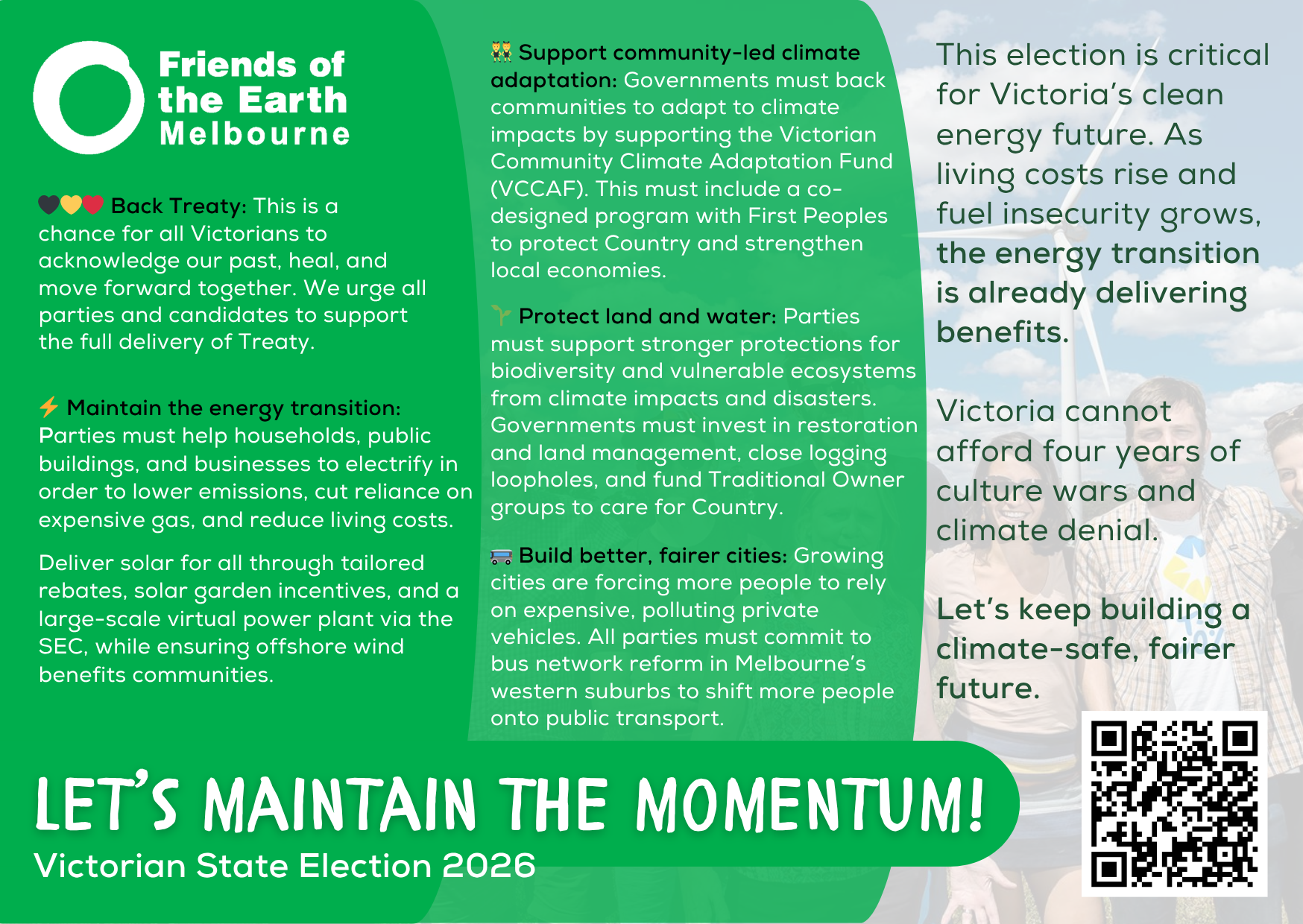
This is a critical election for Victoria if we are to secure the clean energy future our communities have fought hard for. With the energy transition now well underway and an ongoing fuel crisis, it is essential that we maintain momentum in the shift to renewable energy, storage and efficiency. Maintaining the transition will reduce our contribution to global heating and also deliver economic benefits to households and businesses.
After a shocking summer of bushfires we know that many impacts of global heating are already locked in. That' s why we need to ensure that all parties and candidates are focused on the need to support climate resilience in communities across the state.
As most people struggle with cost of living pressures, it is wise to remember that the energy transition is already delivering benefits. We cannot afford to waste 4 years on culture wars and climate change denial.
This page features our work in the lead-up to the November 2026 Victorian state election
What do parties and candidates need to do?
Our policy
Please scroll down to find our policy around what we want to see delivered at the election - we would encourage you to use it to ask your local candidates if they are willing to support strong climate and environmental policies.
The pillars of our campaign platform is for all parties to:
- Back Treaty
- Maintain the energy transition
- Support community resilience to the impacts of climate change
- Build better, fairer cities
- Protect land and water
- End Plastic Pollution - Kickstart the Reuse Revolution
Our shared policy with the climate movement
Working with many allies in the climate movement we can created a shared policy platform, which you can read here.
Take action
Sign on to our vision
You can sign our open letter to candidates and parties here, which urges them to commit to a visionary program of climate, energy and environmental commitments in the leadup to the November 2026 state election.
You can influence the debate by sharing our letter with your local candidate or political party. Call them and organise a meeting and ask them to commit to back our policy platform. Let us know if you need a hand with this.

Support our call for a moratorium on all assessment and approvals of critical minerals projects.
Across north western Victoria and in Gippsland, critical minerals projects pose a threat to farming, water and the environment.
Please support our call for a pause on all assessment and approvals until there has been a thorough assessment of the cumulative impacts of these projects.
Get involved
If you would like to get involved in your local community as part of the FoE campaign, please get in touch to discuss: [email protected]
We are looking for people who are interested in:
- joining our rapid response network. This is a group which is alerted when we want to try and boost positive (or challenge negative) statements from candidates/ parties, especially in the social media space.
- helping out with stalls at public events like markets and festivals
- joining our action group, who will be organising stunts and actions in the lead up to the election.
Get involved in our public actions (newer events towards the top of these listings)
- Electrify Karingal 3199
As the price of gas continues to rise, have you wondered about electrifying your home? Join your neighbours at Karingal Place to learn about why now is the time to get your home off gas, and how to do it!
Hear from local residents, community campaigners and industry experts.
August 20.
- Empowered Maribyrnong
This event is proudly hosted by Friends of the Earth Melbourne, Rewiring Australia, Smart Energy Council, Electrify Maribyrnong and Maribyrnong City Council.
Victoria's transition to all-electric homes and businesses is accelerating, creating opportunities for lower energy costs, healthier homes and reduced emissions. However, many households continue to face barriers to accessing these benefits, particularly during ongoing cost-of-living pressures.
This workshop is designed to empower community leaders, advocates, connectors and local champions with the practical knowledge, skills and resources needed to support others on their electrification journey.
Join us for an evening of inspiring speakers, interactive discussion and networking over dinner. Through a four-corners style workshop, participants will build their understanding of home electrification, learn how to identify opportunities and support pathways for residents, and explore effective ways to share information within their communities.
Thursday August 27.
- Transport Justice rally, June 18
 Our next state election focused event will be our transport justice rally at Parliament House on thursday June 18.
Join the Sustainable Cities collective and Mt Atkinson Advocacy Group for a rally at parliament calling for Transport Justice for Melbourne's West!
Its been 5 years since Labor released Victoria's Bus Plan and we are still waiting for Better Buses! Meanwhile, the Melton line electrification is years away, and new suburbs like Mt Atkinson have been waiting for years to see any plans for a train station for their community. Car parks are full by 7am, and hardworking Westies are spending hours and hours in their car to get to work and school.
Access to public transport is crucial for improving a sense of safety, dignity and connection for the hardworking people of the west. Public transport is an essential service that allows access to other essential services like healthcare and education.
Parliament House steps, midday
It would be great to see you there. Further info here.
- Join our launch event
On Thursday June 4 we will be hosting an introduction to our state election campaign.
This will be an online event, running from 6 - 7pm.
You can register here. This is a free event.
- Join our climate movement campaign launch
You can join the statewide Victorian election climate convergence, which will happen on Saturday May 23 by registering here. This is a free event but places are limited so please sign soon!
Support our work
Please consider supporting our work with a tax deductible donation. You can do so here.
Or consider joining up as a member of Friends of the Earth - details are here.
What do parties and candidates need to do?
Back Treaty
This is a historic moment for our state, with the Treaty with First Peoples having been adopted by parliament in 2025. After nearly a decade walking the path to Treaty, and generations of resistance and activism from First Peoples, Australia’s first Treaty is here. This is a chance for all Victorians to acknowledge our past, heal and move forward together.
We urge all parties and candidates to accept the opportunities in this historic moment and commit their support to the full enacting of the Treaty.
“Treaty recognises that Aboriginal people are the experts when it comes to our Country, culture and communities – and makes sure we can use our local knowledge to come up with and deliver practical solutions to improve health, education and housing outcomes for our communities.” Ngarra Murray
Maintain the energy transition
Victoria's ageing coal fired power stations are increasingly unreliable, and Yallourn will close by 2028. Victoria needs to maintain the shift to renewable energy if we're going to keep the lights on and act on climate change.
We can maintain Victoria’s position as the national leader in renewable energy by upholding Victoria’s legislated clean energy targets. Any attempt to undermine them will send our state backward and increase costs for energy consumers.
Gas: with declining supply, fossil gas prices can only go up. We need a rapid and equitable plan for getting people off gas. A jobs rich approach means supporting local job procurement and retraining of tradies. It means putting in roadblocks to new oil and gas extraction.
Electrification: we urge all parties to offer sound policies to help homeowners, renters, public buildings and businesses electrify to end reliance on expensive gas, improve the cost of living and reduce polluting greenhouse gas emissions. More renewables in the system will bring down prices.
We should offer additional discounts on all electrification/ efficiency rebates to people with government concession cards (e.g. low income/ healthcare cards).
There must be safeguards against landlords passing the cost of electrifying their properties onto renters.
Parties should resource the Supported Energy Transition (SET St) concept to be rolled out across metro Melbourne.
Deliver Solar for All: Deliver a package to help locked out households access solar by offering tailored rebates, incentivising solar garden projects and piloting a large scale virtual power plant through the SEC.
Rollout Local Energy Hubs: Deliver a network of locally led centres providing services to support communities in understanding and participating in the shift to renewable energy, from the small stuff to the big stuff.
Make sure offshore wind delivers for communities: Match Victoria's ambition on offshore wind jobs by offering a comprehensive community benefits package that benefits regions hosting projects.
Unlock the Missing Middle: Upgrade distribution networks to enable more small and mid scale renewable energy development such as on-farm solar and batteries and community led wind and solar projects.
New power. Make it Public. The best electricity is renewable. And the best form of renewables is community or public ownership: that’s why we support the continued investment of the State Electricity Commission (SEC) in new renewable energy and storage.
Support community resilience to the impacts of climate change
Many communities know what they need to do to adapt to the local impacts of climate change. Governments should support their aspirations. Parties should commit to supporting the Victorian Community Climate Adaptation Fund (VCCAF) to allow communities to enact local climate adaptation solutions that also support healthy and thriving local economies. This should be matched with a program co-designed with First Peoples to Protect Country.
Scale Up Energy Resilience: Expand Victoria's successful energy resilience program by doubling the number of community hubs with backup energy systems to help regional communities become more resilient to disasters.
Build better, fairer cities
As our cities grow, more and more people are being forced to rely on expensive, polluting, private vehicles for work, study and family life. While electric vehicles offer opportunities for many, we must ensure that accessible and frequent public transport is available for everyone.
Outer suburban and regional communities are hit hardest when it comes to underspending on public transport. Melbourne’s western suburbs have recently been named the fastest growing area in all of Australia, with the population forecast to reach 1.46 million people by 2046, yet public transport infrastructure does not meet the increasing demand. The government needs to act now to ensure that hardworking families living in the west aren’t locked into a future of expensive, polluting car dependency. The cheapest and easiest solution to solve the public transport crisis in the west is bus reform.
All parties should commit to a transformational network reform of buses in Melbourne’s Western suburbs to enable a shift away from cars and onto public transport. This needs to be coupled with investments in walking and cycling infrastructure to enable maximum mode shift out of cars and into public and active transport. This is a key measure towards reducing Victoria's transport emissions which are the second largest and fastest growing source of emissions in the state.
Protect land and water
The end of native forest logging was a momentous win for Victoria’s unique wildlife, ecosystems, and carbon storage capacity. The subsequent forestry transition included a record amount of government investment into regional Victoria. All parties must ensure that legislative loopholes are closed, so that logging of native forests cannot return under future governments and regional communities can continue to move forward towards sustainable livelihoods.
Legislative loopholes that currently leave Victoria’s native forests exposed to new forms of logging must be immediately addressed and accountability measures to ensure biodiversity values are identified and protected during all state land management activity implemented.
All parties must commit to funding Traditional Owner groups to ensure First Peoples are fully resourced as decision makers and managers of Country. Governments should also rebuild biodiversity jobs and skills within state land management agencies (including in regional Victoria), re-establish Sustainability Victoria, and sufficiently invest in land restoration & management.
Governments should maintain and expand funding for FFMV firefighters for the rapid detection and suppression of bushfires and support CFA volunteers. Parties must support plans to protect biodiversity values and vulnerable ecosystems from climate disasters and impacts.
End Plastic Pollution - Kickstart the Reuse Revolution
The urgency of the plastic issue can no longer be understated. Every day, the equivalent of 2,000 garbage trucks full of plastic are dumped into the world’s oceans, rivers, and lakes, choking ecosystems and communities.
Reuse Acceleration Fund: We aim to drive a shift from single-use plastics to reuse and circular systems. Victoria’s Container Deposit Scheme provides an ideal foundation for return logistics. We need to scale this up into a proper reuse system, through packaging design and Reuse Acceleration Fund. International examples from Europe and Latin America show that refillable beverage bottle systems can reduce lifecycle emissions by 40–55% and reduce packaging waste by up to 90%. For example in Germany 42% of all beverages are filled in refillable containers.
Authorised by Cam Walker, 312 Smith street, Collingwood.