
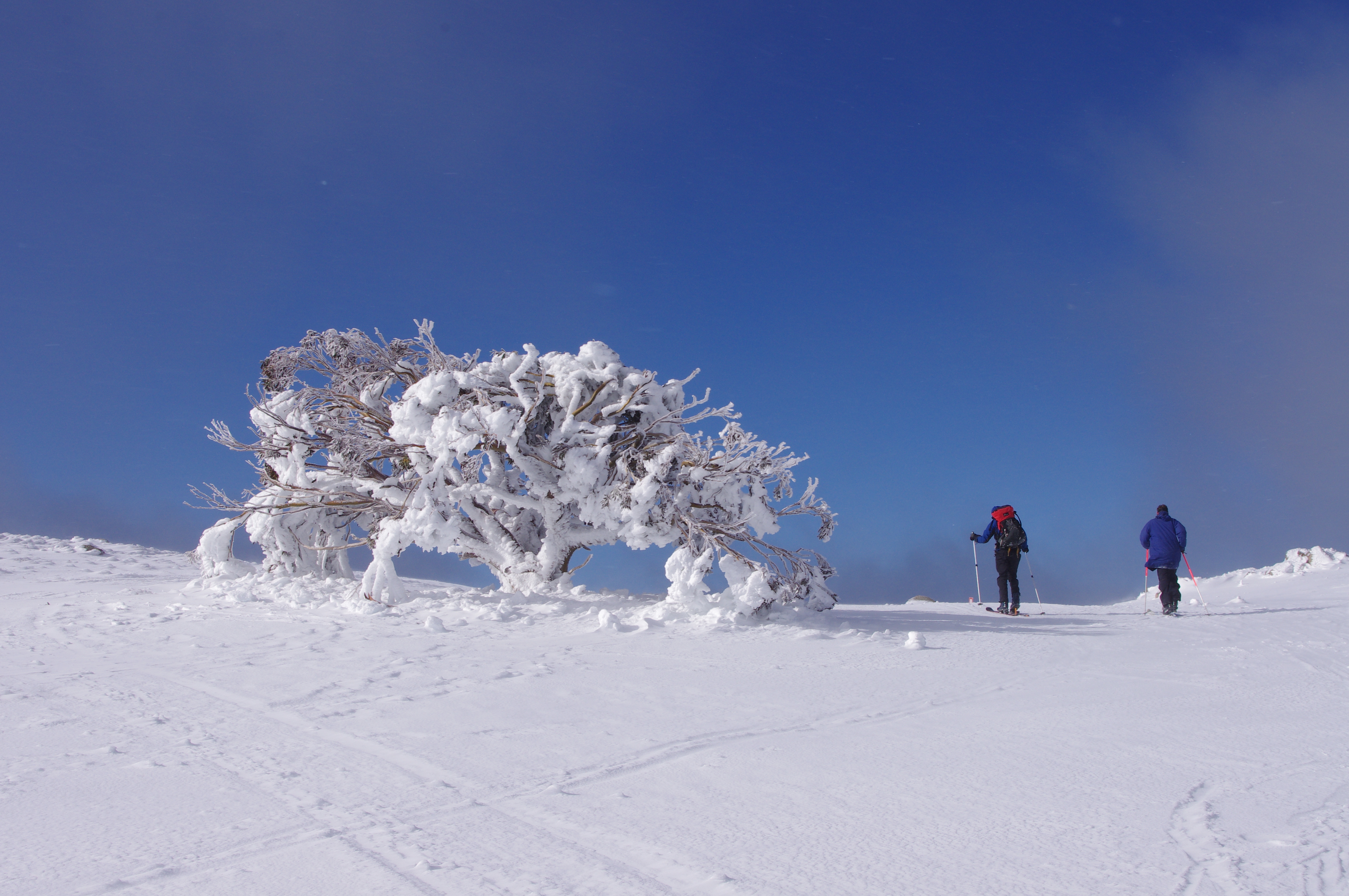
 Snow gums are the iconic vegetation species of the Australian High country.
They are beautiful, vital for biodiversity and tourism, help hold snow pack which is released into river catchments, and hold deep cultural value for many people.
However, we are now seeing the beginning of ecosystem collapse across these forests – drought, dieback and successive fires have altered the structure, composition, and condition of snow gum woodlands dramatically.
Over the last weekend of August (29 & 30) we want to invite resort and mountain loving communities to join us for a couple of hours of citizen science to better understand the health of local snow gum forests. This can happen anywhere that snow gums grow naturally. This will involve walking (or possible skiing or snow shoeing) through an area of forest and recording the health of individual trees.
Read on to find out more.
Background
We must intervene and develop a robust recovery plan if these ecological communities are to remain viable into the future.
Friends of the Earth (FoE) is preparing a proposal to seek threatened species listing for snow gums under federal environmental laws (called the EPBC).
If successful, this will help deliver:
· Legal protection and regulatory measures
· Greater access to funding for research and restoration
· National Coordination
· Public awareness and profile of snow gums
· Elaboration of a National Recovery Plan (and Recovery Team)
We believe this is the best chance we have to get the federal government's attention and channel sorely-needed funding to snow gum science and conservation work.
There are many ways you can get involved to support the listing application – and here is our next action: a weekend of citizen science to map the health of snow gum trees so we can gain a better understanding of the overall status of these ecosystems. We encourage you to join us.
The weekend
Over the last weekend of August (29 & 30) we want to invite resort and mountain loving communities to join us for a couple of hours of citizen science to better understand the health of local snow gum forests. This can happen anywhere that snow gums grow naturally. This will involve walking (or possible skiing or snow shoeing) through an area of forest and recording the health of individual trees. This can be done via a free online app.
If you're busy over the August weekend, you could hold your local event at any time up until the end of August, when we plan to compile the data.
We are currently seeking volunteers to host a local event at their resort or in their community or favourite place in the mountains.
It’s a simple process:
1/ JULY. We hope to find a local organiser or convenor at each resort or area who will co-ordinate the day locally. For instance, Protect our Winters will organise the day at Mt Hotham. We would like to see events in all ski resorts, plus any areas where a local group has an interest in/ connection with snow gums – for instance we already have a group that looks after a hut on the Bogong High Plains join the initiative! We are approaching outdoor clubs and businesses, schools, environmental educators, resort and tourism operators, and anyone with a connection to snow gums.
We ask the local organisers to pick a day (August 29 or 30) and a place to meet. We suggest that each event go for a couple of hours (obviously dependent on the weather conditions on that day) and finish with a group photo that can be used in the campaign and some sort of social event – a beer at your local pub, a picnic on a hilltop, etc.
Please let us know if you want to host an event by July 31. Email: [email protected]
2/ AUGUST 12. We will hold a second online session for all local organisers - so everyone understands the data gathering methodology, gets any support they need, and to co-ordinate advertising, etc. This will happen via zoom from 6 - 7.30pm on August 12.
If you would like to attend the briefing, please rsvp here.
3/ Once we know your plans, we will create a rsvp page for each event so people can register (knowing how many people will attend is important for planning how to run the event and how big an area to map).
4/ AUGUST. We will advertise the events via partner networks, ski resorts, snow and regional media, etc.
5/ AUGUST. Host the events. Have a wonderful time. Share it on your social media. At the end of the day, we ask you to share your tree health data with FoE, who will compile a media release and a report for MPs and other decision makers.
We also intend to host a second citizen science weekend sometime over summer.
Surveys planned for August 2026
Mt Hotham alpine resort
Save Our Snow Gums Survey, 2pm Saturday 29 August 2026, Mt Hotham.
Love Snow Gums and want to help protect them?
Our snow gums are under threat: from increasing bushfires and from the devastation wrought by the longicorn beetle, which is thriving under a warming climate. Protect Our Winters (Bright chapter) are helping out on the wonderful Save Our Snowgums campaign, run by Friends of the Earth.
This campaign will persuade the Australian environment minister to add snow gums to the list of threatened species, leading to increased funding for their protection. With funding, scientists can work out ways to stop the spread of the longicorn beetle, for example.
From 2pm to 4pm Saturday 29th August, we will survey the snow gums around the General Hotel, Mt Hotham. It should be a fun afternoon, no experience is needed, and we will finish for a well earned soda water or beer at the Genny afterwards.
Kids and families particularly welcome!
What: Save Our Snow Gums Survey
When: 2pm, Saturday 29 August
Who: Please get in contact with Lily O'Neill if you would like to join, [email protected]
Paw Paw Plain, between Hotham and Dinner Plain
 Australian Backcountry Festival
This survey will happen from 9am until 1.30pm on Saturday August 29.
This will happen as a tour within the program for the Australian backcountry festival - the annual three day event that happens in and around Mt Hotham resort. So you need to have a general ticket to the festival and then register for the Friends of the Earth/ Protect our Winters snowshoe tour. You can find the program here.
If you're super keen to just attend the survey but not attending the festival, please consider joining the POW event near The General hotel on the same day (see listing above).
Dinner Plain
This survey happened on July 17. There is a report on the survey available here.
Alpine School Dinner Plain
This survey will we carried out by students from the school and happen Thursday August 27.
Wangaratta Ski Club
This survey will happen Sunday August 23 at 4pm. Meet at Wangaratta Ski Club on the Great Alpine Road to join Wangarratta Ski Club members to survey Snow Gums surrounding their clubhouse after a day of skiing. RSVP here.
Falls Creek
Full details soon.
Bogong High Plains (a number of locations)
These are being organised by a range of groups and are not public due to the logistics of getting out into the area. Locations include around Johnston's hut, Wallaces hut and other areas around the eastern side of the High Plains. Thanks to Federation University outdoor environmental education students, the Mittagundi outdoor education centre, and the Johnston’s Hut Musicians for their involvement in the surveys.
Mt Macedon
This survey will happen on Saturday August 29 and will be hosted by Macedon & Mt Macedon Landcare Group after their existing tree planting event. Join them for a full day of planting and citizen science. Meet at 2pm, Memorial Cross Car Park, Cameron Drive, Mt Macedon. For the Snow Gum citizen science part of the day, census, we will be surveying around the Mt Macedon Summit and Memorial Cross. If there's enough people and time, we will move to also survey around Camel’s Hump.
The Snow Gum planting session will run from 10.30am - 1.30pm, which people are welcome to participate in. RSVP here.
Lead Contact: Kate Lawrence, 0402 080 445, kate@storyground.com.au
Mt Buller
Alpine Resorts Victoria (ARV) is inviting the Mt Buller community to join in the surveys which will happen at Mt Buller Alpine Resort. The proposed survey areas will be across the Mt Buller village and its perimetre.
This survey will happen on Saturday August 29, between 10:00 - 1pm. Full details here.
.
Mt Stirling
This survey was hosted by Friends of the Earth and happened on Saturday August 1. You can find extra info and rsvp here.
There is a report from the survey available here.
Mt Torbrek
Join Upper Goulburn Intrepid Landcare to survey Mt Torbrek (Geebar) on Sunday August 30. RSVP & more info here.
Lake Mountain
This survey will happen on Sunday August 23 led by Friends of the Earth and Cathedral Landcare Group. RSVP & more info here.
Mt Feathertop
This is another event that isn't open to the public due to the difficulty of accessing the area around the summit of Mt Feathertop. Thanks to the Melbourne University Mountaineering Club (MUMC).
JB Plain
This area is in the Alpine National Park between Dinner Plain and Mt Hotham, and this survey will be hosted by Friends of the Earth. This is suitable for families with small children as most of the surveys will happen close to the Great Alpine road. Sunday August 23.
There is a report on this survey available here.
NSW & ACT
Thredbo Alpine resort NSW
This survey will happen Saturday September 5, organised by Protect our Winters Jindabyne. They will focus on assessing Snow Gums within the resort bounds. Meet at Gunbarrel chairlift at 9am. Skis or snowboard will be required, as will a lift pass. RSVP here.
Namadgi NP ACT
This survey will happen on Saturday August 29 led by National Parks Association (ACT). The plan is to conduct a small ACT survey of Snow Gums to get an idea of their health. The survey will involve walking through the bush in a grid pattern search for perhaps 4 hours with a break for lunch. The location will probably be Mt Franklin Road but this depends on some preliminary searching and advice from local experts. Limit of 8.
More info & RSVP here via NPA events page.
To get involved
If you would like to host or co-host an event in your community, resort or favourite mountain please get in touch asap.
We will ask all local organisers to create a risk assessment plan using a template so that participants can be covered through public liability insurance.
We are aiming to lock in all events by July 31, and will then advertise all events after that.
Contact:
Cam Walker - 0419 338 047 / [email protected]
Anna Langford - 0478 031 771 / [email protected]
Find out more about the listing process here via this open letter.