The summer of 2025/26 saw terrible fires burn across Victoria. Approximately 440,000 hectares of land was burnt, 451 homes were destroyed, and there were huge economic impacts and loss of wildlife and farm animals.
In response, the Victorian parliament announced an Inquiry, to be run by the Environment and Planning Committee of the upper house. After receiving hundreds of submissions and holding many public forums, the committee delivered its Final Report to Parliament on 28 July 2026. The Government has 6 months to respond to the report, which is available here.
The final report contained 93 Findings and made 80 Recommendations, across the extent of its broad Terms of Reference.
This is a quick report back to our members and supporters, and an assessment of the findings and recommendations that most relate to environment, land management, and climate change and which could be implemented relatively easily and in a short timeline.
Our submission to the Inquiry can be found here.
We appeared before the Committee at the hearings held in Harcourt and the transcript of that can be found here.
Text in coloured font is taken directly from the committee report.
Some reflections on the Inquiry & minority reports
We appreciate the huge amount of work that went into the committee’s report. We also note that there are two minority reports, one from The Greens and one from the Liberal and Nationals members of the committee.
We note that The Greens report includes reference to the need to reduce our reliance on fossil fuels (voted down by the other members), the need to make the large polluters pay for the damages they are causing through longer and more intense fire seasons, and references to FoE’s work on climate adaptation.
Greens references: Mitigation
Multiple submissions, including from Friends of the Earth, Doctors for the Environment Australia, and Climate Action Team Colac Otway, argued that the 2026 bushfires
reinforced the need to take stronger action on climate change by banning new fossil fuel projects, urgently transitioning away from fossil fuels, and ensuring that policy settings
across government supported this.
Adaptation
The need for significantly more climate resilience funding was raised in evidence received by the committee in the current inquiry, including Friends of the Earth Melbourne. In their submission, they cite evidence from the CSIRO highlighting that a $1 investment in climate adaptation or disaster risk reduction leads to a $2-11 saving in post-disaster costs.
Given the enormous cost of bushfire events, investment in preparation and adaptation presents a clear economic benefit.
Recommendation: That the Victorian Government implement Recommendation 6 of the Climate Resilience Inquiry report.
There are a number of practical recommendations in the minority report from the Liberals and Nationals that we support. We do note that they have thankfully avoided proposing a hard hectare or percentage target for fuel reduction, although they do suggest implementation of ‘minimum fuel treatment requirements’ for burning. This is a dangerous path as it runs the risk of ‘burning to meet targets’ rather than ‘burning to meet outcomes’, and potentially pushes land managers to burn in conditions where weather conditions are not suitable for ignition to occur.
A key finding is the observation that climate change is driving the frequency and intensity of fire seasons
A key thing to note is that the committee acknowledged that climate change is a key contributor to the conditions that fires burn in, and is adding to the frequency and intensity of fires. This is consistent with everything we know about climate change and science.

Unfortunately, the Liberal, National and One Nation (PHON) MPs on the committee took the decision to oppose this section in the report (story here). It would seem that these parties are willing to ignore accepted science in order to pander to a perceived climate denier base. While this has long been the case with PHON (with Malcolm Roberts seen as their ‘leading light’ on climate science) it is disappointing to see the Liberals also moving firmly towards outright climate denial.
For the record, it is worth noting that all fire authorities in the country accept the role of climate change in driving worsening fire seasons. You can see a summary of their positions here.
Jason Heffernan, CFA Chief Officer, who presented at the public hearing in Melbourne, described conditions that are becoming more common under climate change:
“The most dangerous period arrived between 7 and 9 January, peaking with catastrophic fire danger forecasts across multiple weather districts. There were widespread temperatures well into the 40s, with a large dry air mass, damaging winds and atmospheric conditions generating lightning strikes into the baked Victorian landscape”.
The report also noted that climate change is reducing the window of opportunity to conduct fuel reduction burns, something that is usually overlooked by those who demand additional burning or hectare targets for burning programs.

The committee supported extending the remote area firefighting team to expand opportunities for urban-based people
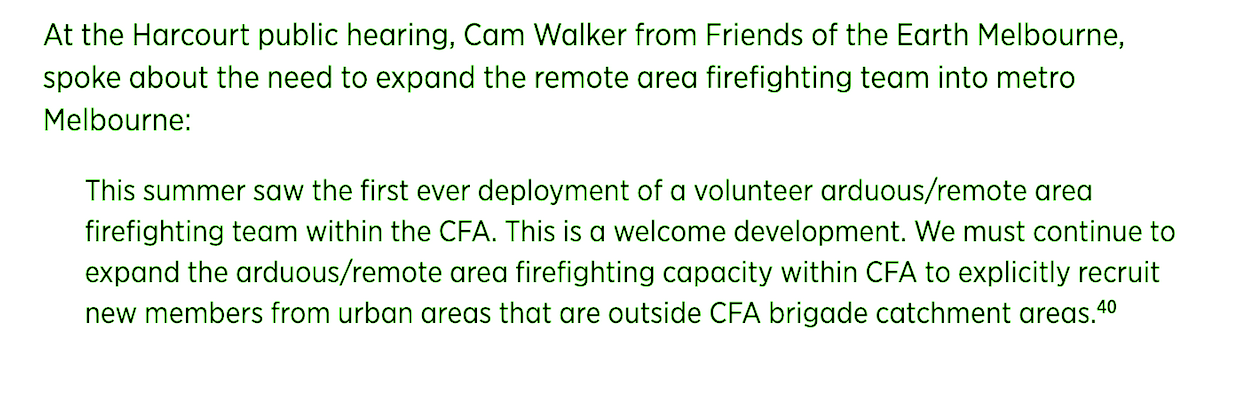

This is good to see. The creation of a remote area firefighting team within the CFA in 2025 brings Victoria in line with other states and territories. Having volunteer arduous firefighters means they can support the excellent work of FFMV arduous and remote crews and also be available to support interstate deployments. More remote area fire fighters means more ability to get onto small isolated fires quickly before they grow into uncontrollable blazes.
The CFA Remote Area Fire Fighter (RAFF) team is now in its second year. FoE’s model for developing the RAFF capacity is to structure it in a way that will allow people living in Melbourne who currently cannot volunteer with the CFA as they do not live close enough to a fire station to get involved.
We have identified a pathway for people to train to be a RAFF regardless of where they live in the state. Creating opportunities for people living in large centres like Melbourne and Geelong can be expected to increase diversity within CFA volunteers and attract many young people to firefighting.
Having volunteer teams based in urban areas would:
- represent a new way of building firefighting capacity,
- build diversity within the CFA by attracting young people and people of diverse backgrounds,
- help relieve the burden on existing rural and regional fire brigades who are expected to provide people for deployment as strike teams through summer, and
- could be delivered at a very small overall cost to the taxpayer.
Climate change is supercharging fire seasons. It is putting new burdens on existing firefighters and their families and on state budgets. Providing opportunities for city based people to volunteer their time in firefighting efforts would be a smart response to the reality of longer and more intense fire seasons.
You can read more about our proposal here.
The committee noted our concerns about the ecological impacts of current fuel reduction burning
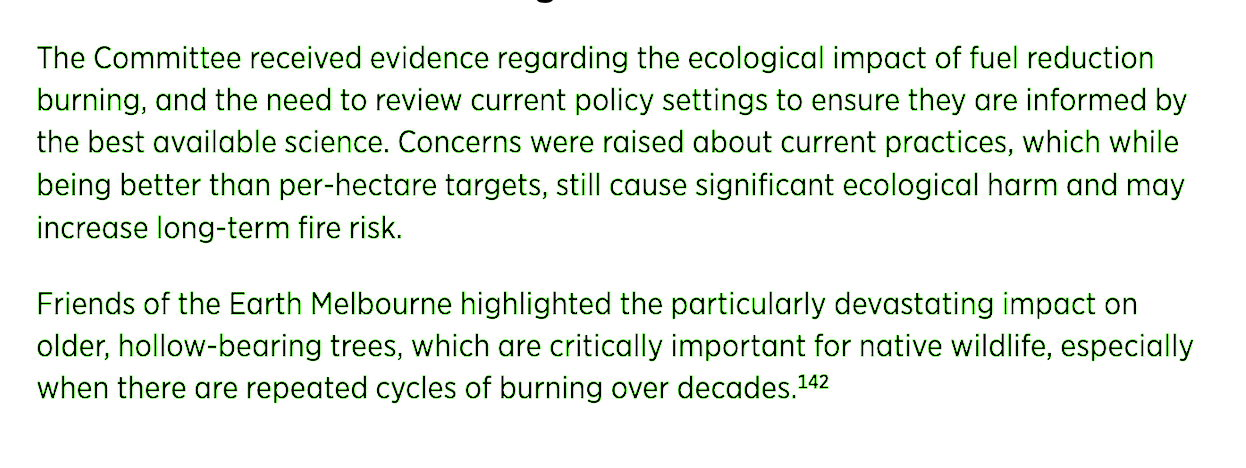
You can read more about our approach to fuel reduction burning in our submission to the inquiry.
The committee noted our concerns about ‘over zealous’ destruction of trees in burnt areas
We fully understand the need to make areas safe for emergency workers and the community after a fire, and this includes the need to assess and remove potentially dangerous trees. However, we have seen many instances in the past - for instance after the Beyindeen - Rocky Road fire of 2024 - where post fire tree removal was so unacceptable that a local in Beaufort organised a planning lawyer, and took the council to VCAT and won. The residents used a well respected arborist as an expert to balance the contracted arborist.
The residents asked VCAT to force the council to develop a specific standard for assessing bushfire affected trees, as such a framework doesn’t exist. Council refused to do so and there is still no such standard. But as fire seasons get longer and more intense, we have to expect to be dealing with ever larger bills for clean up in coming years, so it makes sense to create a framework to assess the complimentary issues of ensuring protection of the public and ecological values.
Until there is an enforceable standard to ensure healthy trees are not cut down in clean up efforts, it will remain up to community groups to watch dog clean up operations.
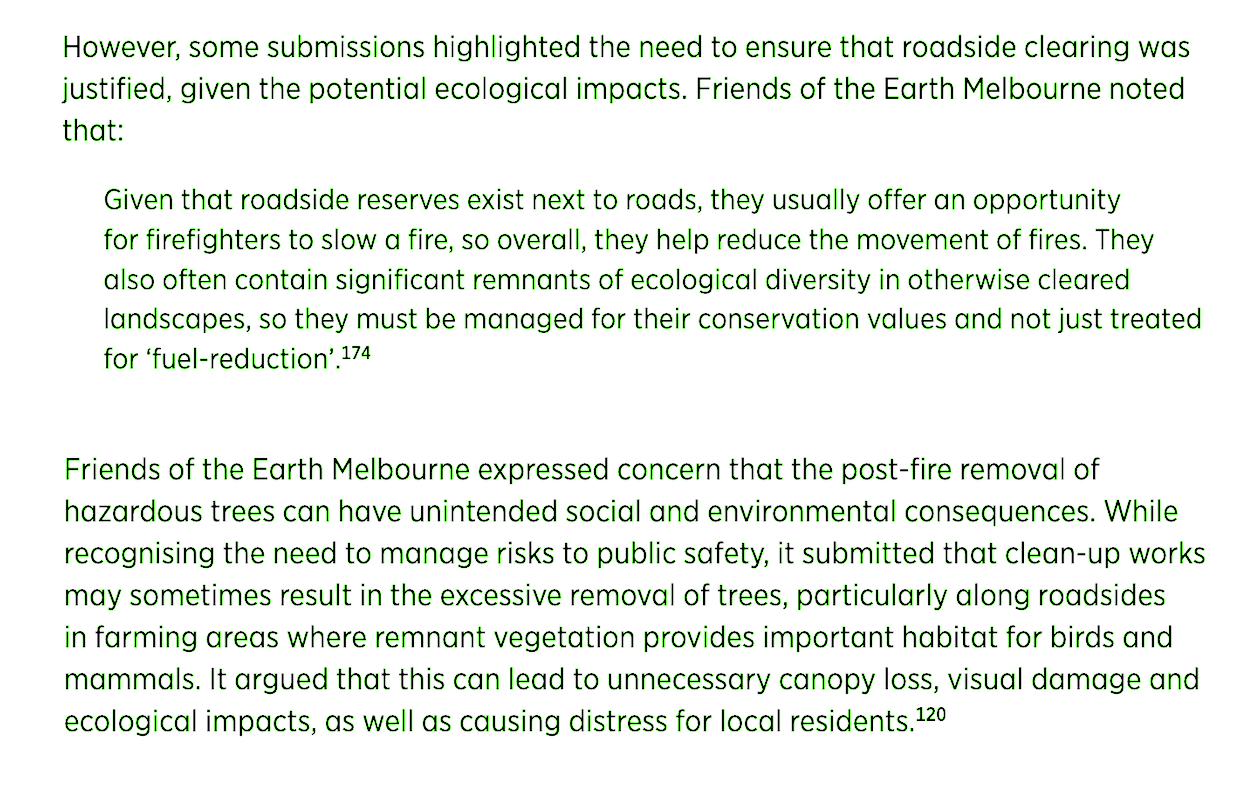
This perspective was represented in the following Finding.

We must start to prioritise protection of the environment during large fires
The report clearly demonstrates the scale of the ecological damage of this summer’s fires (section 4.3.5 in the report). This includes details on areas of forest that have been burnt multiple times in the space of only a few years. As climate change makes fire seasons longer and more intense, we must be willing to allocate the necessary resources to protect fire sensitive and at risk native vegetation communities and animals.

In the case of larger fires, a series of priorities influence the creation of a campaign plan, which then decides how fire fighting resources will be allocated to fight the fire. The safety of firefighters and other responders is paramount, and then there is a hierarchy of priorities until at the end of the list ‘protection of environment’ appears. While we fully appreciate the need to protect emergency responders, members of the community public and private assets, we also see the need to protect fire sensitive ecosystems.
We believe that a logical approach is to systematise the need to protect the environment when preparing fire management plans on larger ‘campaign’ fires. This could be done simply by creating a requirement for incident controllers to develop a plan to protect ecological assets as they also plan to protect humans, houses and other structures.
This is a really significant and easily implemented proposal which would add considerable protection to at risk communities. There is a report on fires from 2024/25 in the Victorian high country where incident controllers included protection of ecological assets in their fire plan (available here) which demonstrates what is possible once the environment is a priority.
The process - hearing from the community
We commend the committee for hosting a number of public hearings with ‘open mic’ options for community members to get up and speak. As noted in the report, ‘At the open mic sessions, the Committee heard heartfelt evidence about the efforts to contain the fires, the impact on people’s homes, livelihoods and the environment, as well as the adequacy of recovery efforts.’
‘The evidence gathered from fire‑affected communities should be read not only as a record of loss, but as a practical guide to what must change before the next fire season. The recurring themes were clear: preparedness must be practical, local knowledge must be used in preparation, volunteers must be properly supported, communications must work when power fails, and recovery must be funded according to impact.’
Of course, listening is one thing, and acting is another. We do hope that government will commit to responding to the many findings and recommendations that relate to the toll of fires on individuals and communities, and how to best integrate the lessons of last summer’s fires in future planning.
The recommendations
The following are some of the recommendations that we believe could be implemented fairly easily, and should be acted on as a priority.



We also note the excellent work already being done in this space, including the bulk water points that had been established by the CFA prior to the 2025/26 season.

Fuel reduction
The issue of fuel reduction burning, which is intended to reduce fire risk and slow wild fires as they move through the landscape, is a deeply contested issue. While a variety of perspectives were given space, the recommendation regarding the topic was fairly vague:

A key source in the hearings was the head of FFMV, Chris Hardman, who told the Committee that FFMVic seeks to ‘maximise available burn days but climate change is making the task ‘more and more difficult every year’.
Mr Hardman cautioned against treating planned burning as a standalone solution: ‘planned burning is not a magic bullet. There is no silver bullet’.
He described planned burning as part of a wider system that also includes mechanical fuel treatment, the maintenance of a 50,000‑kilometre road network, remote water
points, strategic fuel breaks, aviation, ground crews and contractors.’
Professor David Lindenmayer, Adjunct Professor at La Trobe University emphasised the limits of the burning program, noting that ‘the protective effect generally declines as a
treatment becomes older or more distant from the asset and as fire weather becomes more severe’.
He noted that prescribed burns in forests initially reduce flammability but that ‘after a system has been disturbed and then regenerates there is a pulse of additional flammability that can last for several decades after those disturbances’, in effect saying that burning locks us into more burning if we wish to keep flammability low.
‘His evidence was not that all prescribed burning is ineffective. It was that the benefits of burning are conditional, and that broadscale burning far away from assets may deliver limited protection while carrying ecological and future flammability risks.’
As was noted by Dr Claire Fenuik, from the Conservation Ecology Centre:
‘If we want to build long‑term ecological and community resilience to climate change, not just respond to risk in the short term, then we need to think about bushfires as one aspect of complex and dynamic landscapes. The forests and heaths of the Otways are not just fuel for bushfires. They are social, cultural and ecological systems.’
Ultimately, there was no recommendation to review or change how fuel reduction is done in Victoria, only that there be a ‘science based appraisal’ of fire risk associated to fuel before the next summer.
This represents a significant missed opportunity to call for a deep overhaul of the current burning program and the assumptions and methodologies it is based on.
Roadside reserves
Another hotly contested issue during the hearings was the question of whether road reserves were increasing fire risk. This is another issue that is pushed by the ‘pro burners’ and is often an easy scapegoat where fires have largely run through private land.
Some of the recommendations revolved around ensuring the ability to have roadsides rapidly ‘treated’ (slashed or burnt) if they are deemed to be a fire risk, but we also note that our points about roadside reserves often containing valuable local biodiversity were also included in the committee’s report.

Bushfire preparation

Providing support for brigades to hold information days seems like a ‘no brainer’, especially if smaller and remote brigades in rural areas are prioritized for funds (although we note that brigades have already planned their Get Fire Ready sessions for this fire season).
Supporting community mental health

Evidence given through both submissions and hearings indicated that the impacts of the fires continued well beyond the immediate emergency period. Witnesses across all regions
described trauma, fatigue, grief, anxiety and prolonged recovery stress, particularly in
communities already affected by earlier disasters.
The recommendation for sustained funding of mental health and wellbeing services is of huge importance as Victoria prepares for the impacts of a long and hot summer over 2026/27.

Impacts on animals and farmers
Obviously the economic loss of farm animals can be enormous, but so is the emotional toll of having to deal with dead and injured animals. Facilitating the involvement of professionals to assist with the awful process of killing injured animals will reduce the overall suffering of animals after the impacts of fire.

Communications
There were many problems with communications on fairgrounds during the summer, which is reflected in the significant number of recommendations in this space. Resolving the comms issues before this fire season is of paramount importance.


Appliances
There was a significant focus during the hearings regarding the age of the CFA fleet of fire fighting trucks. The issue has been heavily politicised by the conservative parties and a range of organisations, but in spite of this it is clear that while older fire fighting trucks are being replaced, the rate of replacement has not kept pace with the age profile and there is a clear need to increase the speed of the replacement.
This is also an issue with the trucks of Fire Rescue Victoria, the professional fire brigades who respond to fires in larger metropolitan areas.


Emergency relief, recovery, community hubs
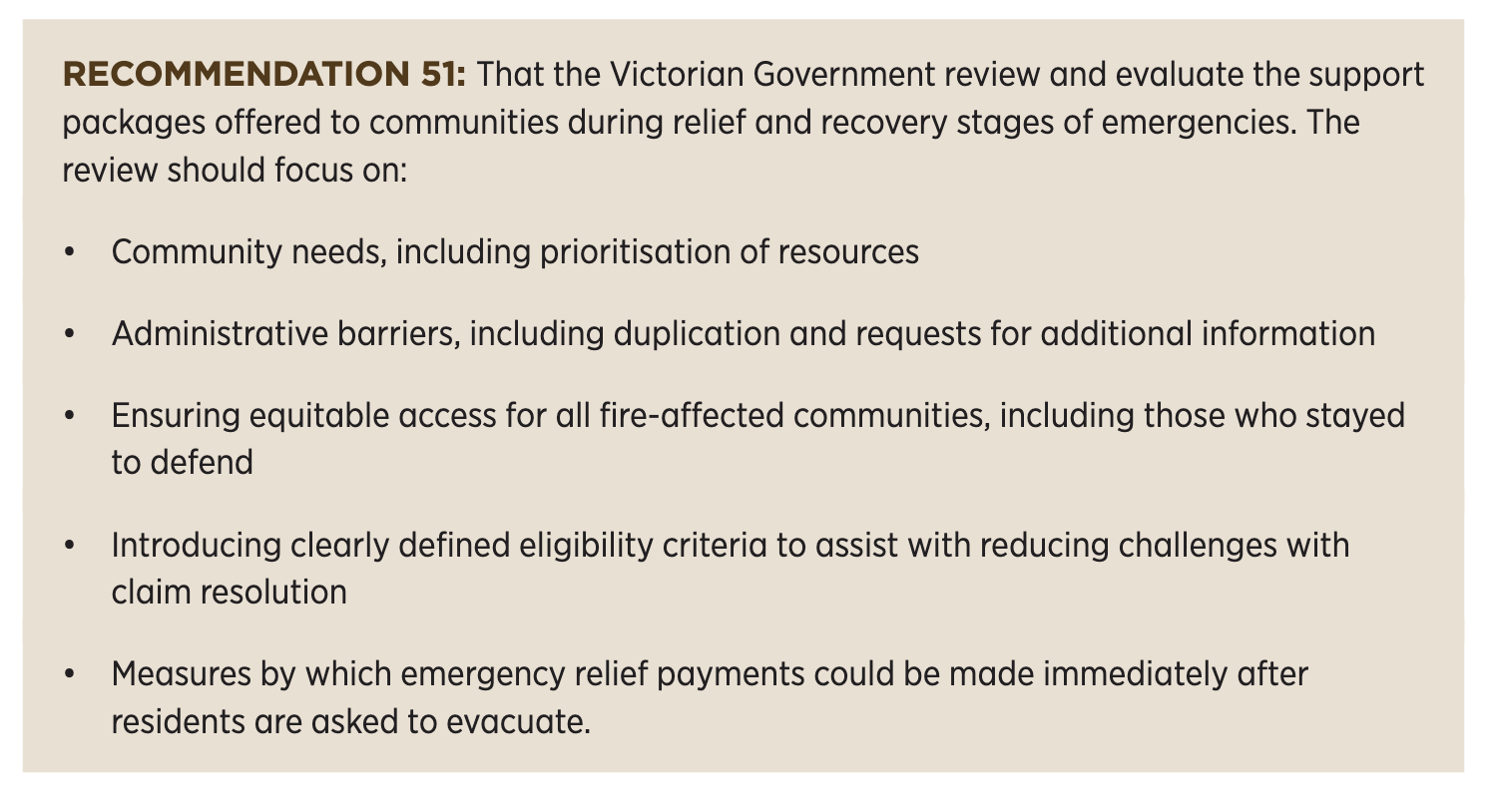
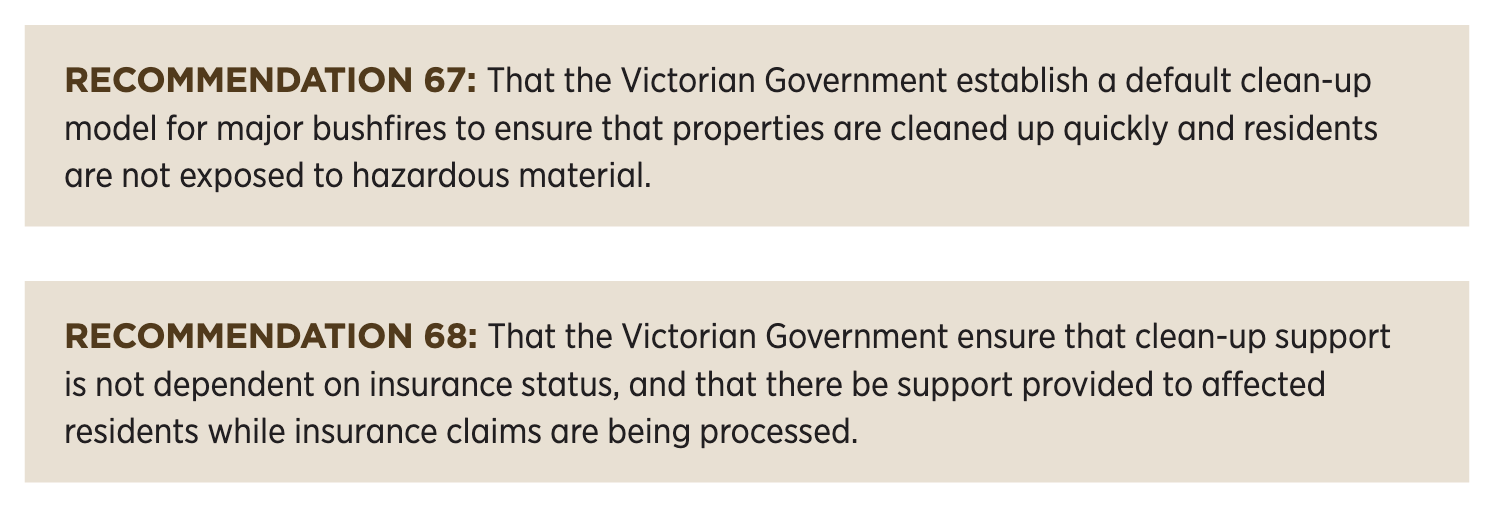
Many issues and concerns were raised in submissions and at the hearings, and many of them could be fixed or resolved relatively quickly.



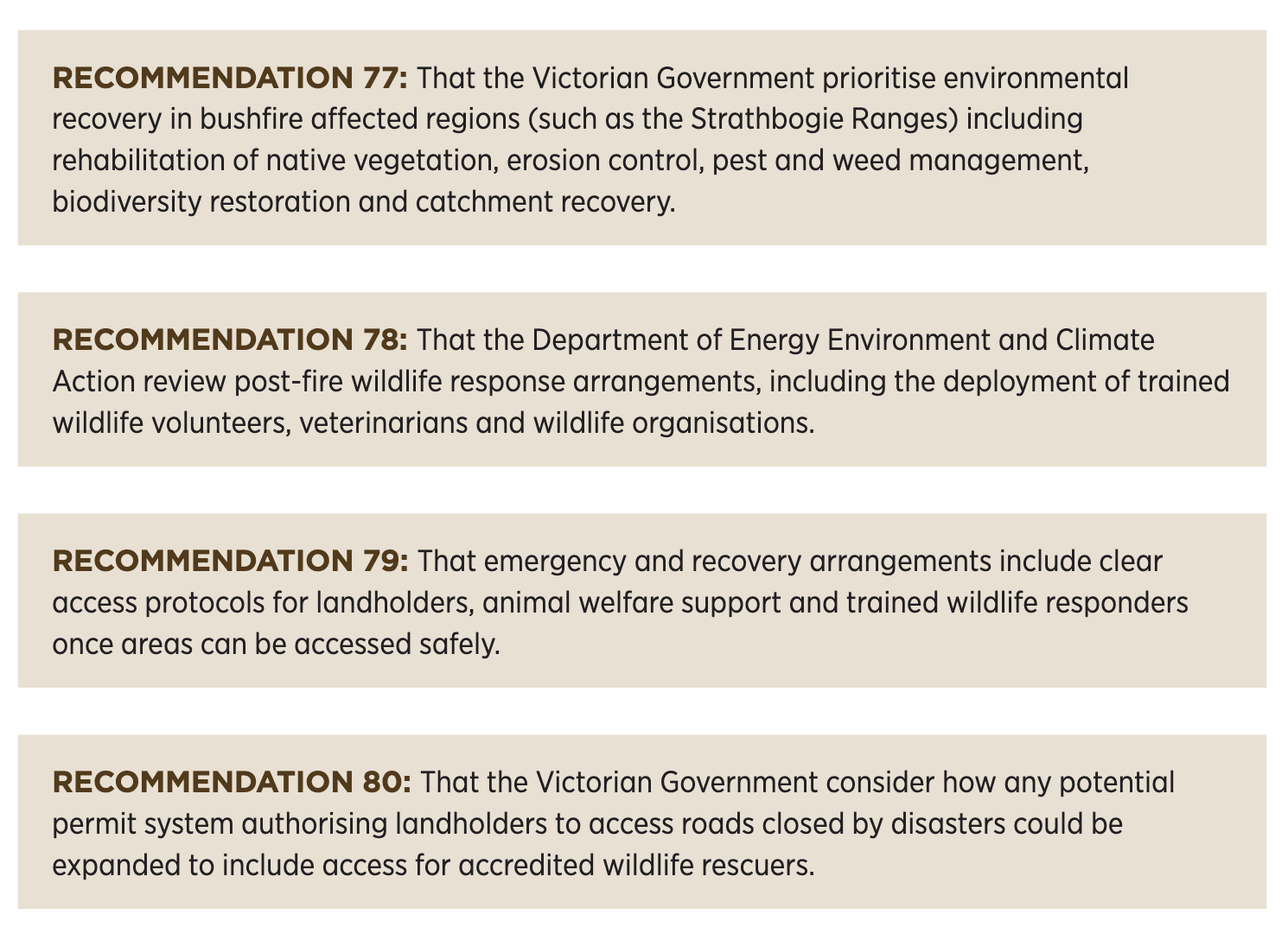
Environment and wildlife