
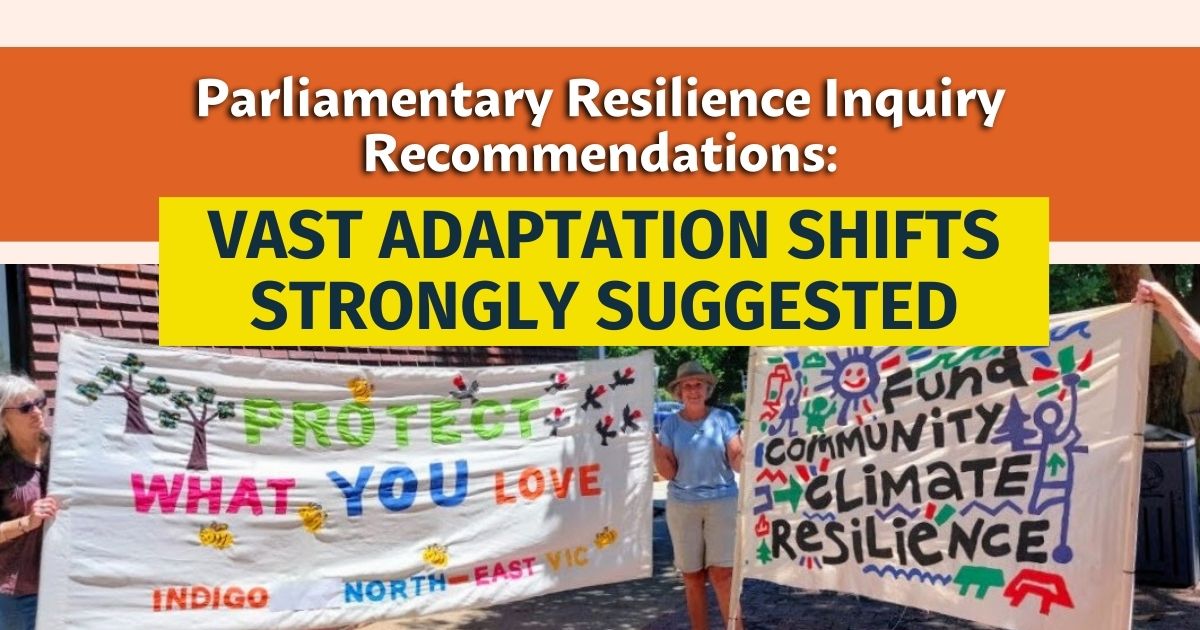
A strong call for the state to step up on climate risks - that’s what the Parliamentary Report for the Inquiry into Climate Resilience amounts to. What’s in it? Find a summary of all the findings and recommendations, as well as AoC and its supporters and allies' impact, below.
Our asks were strongly advocated for, with the report firmly backing up our ask for adequate funding and a VCCAF and other key elements of our campaign, including: ongoing funding, First Nations- and community-led climate adaptation, and just adaptation that considers those most at risk.
Victorian Communities’ Adaptation Priorities Shine Through
Through the Inquiry into Climate Resilience process, Act on Climate (AoC) aimed to highlight the need for climate impact preparation to prioritise communities most at risk and for local community-led solutions, as well as the need for funding. This was done by ensuring people and communities’ voices were heard throughout the Inquiry, sharing their local risks and needs, and the climate adaptation solutions they want to see.
In our community briefings, we asked communities what they wanted to achieve from the Inquiry and suggested focusing on how they want the government to support their community to prepare in their submission. Collectively, what was wanted from the Inquiry included:
- acknowledgement of risks to communities and their concerns
- strong community consultation and involvement in decision-making
- localised, community-led, Indigenous-led solutions
- tangible action from the Government
- a funding commitment from the Government, and
- a strategy for just adaptation.
The issues AoC and its supporters and allies raised increased the breadth of the report, ensuring issues such as equality, First Nations- and community-led adaptation, and climate justice were included. In addition, the solutions required to keep people safe from current and incoming climate impacts advocated for, with incredible backing by individuals and organisations, shone through as informed, just, well-supported solutions.
Our Asks Strongly Advocated For
The parliamentary report mentions AoC’s permanent Victorian Community Climate Adaptation Fund (VCCAF) specifically as a key funding mechanism proposed by stakeholders. “As clearly articulated by stakeholders to the Inquiry, the establishment of a Climate Adaptation Fund can significantly strengthen Victoria’s climate resilience,” the report states.
It adds that “the Climate Adaptation Fund can address gaps in existing funding frameworks, reduce the economic and social costs of climate impacts, and build long‑term resilience across the state”.
Unfortunately it doesn't go as far as making it one of the Inquiry’s recommendations, but it does recommend "providing adequate funding to local government and community‑based organisations to build climate resilience", which is what the fund would do.
The report firmly backs up our ask for more/adequate funding and other key elements of our campaign, including:
- ongoing funding,
- First Nations- and community-led climate adaptation, and
- just adaptation that considers those most at risk.
So What Next?
We now call on the Victorian Government to support the recommendations of the report and to outline clear actions in its response to the report. The Government has six months to respond in writing to the recommendations made, indicating whether it supports them, and it can also outline actions it may take in this response.
As noted in the report, the “increasing frequency and intensity of extreme weather events leads to compounding and cascading effects”, making responding to this report swiftly and decisively vital.
A rapid, strong and clear response supporting these recommendations and outlining the actions it will take is required to show that the Government is taking climate risks seriously and will do everything it can to keep all Victorians safe.
We are continuing our call for community members to meet their MPs to pass on our Climate Resilience Inquiry report and talk about local adaptation needs the need for funding, with the addition of now also asking MPs to advocate for the Resilience Inquiry recommendations to be supported and to outline clear actions outlined in response. Read our briefing for this here and contact [email protected] or [email protected] if you can meet your MP.
The rest of this blog post outlines what is acknowledged in the report, the barriers to building resilience found, and the recommended measures to increase Victoria’s resilience. Acknowledging that this blog post is long (it summarises around 400 pages into 11), an outline of the headings is below to allow people to scroll down to sections they are especially interested in.
TABLE OF CONTENTS
Risks Acknowledged
Localised nature recognised
Calls for Protecting Those Most at Risk
Beyond the Built Environment
Barriers to Building Resilience
-
Need for more / better funding
-
Governance & Adaptation Action Plans Lacking
-
More Collaboration & Clear Responsibilities Needed
-
Up to Date & Consistent Risk Data Absent
-
Securing Community Support
-
Planning & Building System Needs Reform
-
Current & New Housing Stock Concerns
Measures to Increase Vic’s Resilience
-
Adequate Funding
-
Community-Led Initiatives Crucial
-
Embed First Nations Land Management
- note: Planned Burning for Bushfire Risk Needs Scientific Review & Overhaul -
Building Back Better Not Like‑For‑Like
-
Improve State Climate Legislation
-
Greater Guidance & Less Delays in Planning
-
Better Building Design
-
Retrofitting
Risks Acknowledged
The escalating and compounding climate risks facing Victoria, as well as the wide range of these risks, were acknowledged in the report.
It states that “the clear message from stakeholders throughout the Inquiry was that extreme weather and climate change pose a significant risk to our built environment and infrastructure.” And, it notes that “evidence to this Inquiry has raised significant concerns about the cumulative impacts of more frequent and intense weather events on resilience”.
It specifically mentions the Cape to Cape Resilience Project and the need for immediate intervention to prevent “the loss of critical infrastructure, economic decline, increased safety, hazards, environmental degradation, social impacts, and escalating costs due to delayed action.” The Inquiry found that “delays in implementing erosion control measures at Inverloch and Loch Sport are increasing risks to infrastructure, community safety, and local economies”.
Localised nature recognised
The local nature of climate impacts and risk is also acknowledged, with the report identifying how these risks differ in metropolitan and regional areas:
- Due to high population density, impervious surfaces and limited vegetation, Metropolitan Melbourne faces intensified urban heat island effects, increased flooding risk, and greater vulnerability during heatwaves.
- Regional councils are managing extensive infrastructure over large areas, increasingly exposed to bushfire, flooding, drought, and coastal hazards. These risks are compounded by slower restoration times.
It recognises that ensuring localised, scenario‑based climate risk assessments that reflect unique regional vulnerabilities prevent maladaptation.
Calls for Protecting Those Most at Risk
The Inquiry found that “people from disadvantaged and marginalised backgrounds are disproportionately impacted by climate change” and that “responses to climate change must prioritise these groups or risk entrenching and perpetuating their disadvantage and marginalisation”.
“To ensure people who are the most vulnerable to the effects of climate change are adequately supported”, it recommends that the Victorian Government continue to adequately support community organisations, particularly those offering mental health, homelessness and legal support services.
It recommends expanding access to the Climate Safe Rooms program specifically in order to provide vulnerable people and people from low‑income backgrounds with appropriate refuge from extreme hot and cold weather.
It also recommends a review of the Planning and Environment Act, as well as climate legislation and policies, to ensure inclusion of climate justice considerations.
Beyond the Built Environment
This Inquiry specifically focused on the risks to Victoria's built environment and infrastructure, but acknowledging the wider range of concerns noted in submissions, the Inquiry recommends “that the Victorian Government consider further investigation or inquiry into the impacts of climate change on biodiversity, human health, primary production, and industry in Victoria”.
A big gap that AoC noticed in the Inquiry was a lack of attention to the impact of climate risk on workplaces and workers specifically.
Barriers to Building Resilience
According to the report, the key barriers to building resilience in Victoria’s built environment include funding constraints, planning system limitations, gaps in climate risk data, and challenges in securing community support.
In addition to these, which are discussed in more detail below, it finds:
- Telecommunications infrastructure: enhanced backup systems and increased investment in climate‑resilient networks is urgently needed, regulatory frameworks for telecommunications need to be modernised to incorporate forward‑looking climate risk assessments, and accountability for climate resilience outcomes need to be strengthened in the telecommunications industry.
- Energy infrastructure: a review of the resilience of the State’s energy generation and associated transmission, distribution and storage networks is needed, and the delivery of resilience‑focused regulatory reforms for energy infrastructure needs to be accelerated.
- Road, rail and port infrastructure: a strategy that assesses the resilience of this infrastructure and identifies actions to improve its function and climate resilience is needed.
1. Need for more / better funding
“Funding shortfalls represent a critical barrier to implementing climate resilience initiatives,” the report states, adding that “non‑recurrent funding for resilience projects restricts long‑term capacity building and strategic outcomes”.
The inquiry finds that:
- financial constraints will limit the provision of services by community organisations that play an important role in supporting communities to prepare, respond and adapt to climate change, preventing communities from enhancing their climate resilience.
- climate adaptation and resilience investment, particularly for upgrading public infrastructure, stretches many local councils’ financial capacity.
- cost is prohibiting councils from retrofitting existing infrastructure to withstand future climate impacts
- many Councils lack the funding to undertake consistent comparable climate risk assessments
- road and transport networks’ vulnerability is compounded by issues such as funding constraints
- a lack of funding and gaps in how information is communicated prevents greater public awareness of climate change and its effects
The Inquiry “identified gaps in implementation and funding for resilience and adaptation initiatives” in the Climate Change Strategy and Adaptation Action Plans, as well as Regional Climate Change Adaptation Strategies.
It also finds that a more flexible and proactive funding approach is needed to support councils in both emergency response and long‑term climate resilience efforts due to the increasing frequency and intensity of extreme weather events.
Another finding is that “the Disaster Recovery Funding Arrangements (DRFA) create administrative challenges for local governments and limit betterment funding, making recovery efforts less efficient and increasing financial strain on councils”.
The committee notes that assessing funding for resilience activities is challenging due to the disbursement across various portfolios, noting and recommends “a transparent funding framework that explicitly identifies and tracks budget allocations for climate resilience and adaptation initiatives is implemented and reported in updates on progress in implementing the Climate Change Strategy”.
2. Governance & Adaptation Action Plans Lacking
The Inquiry examined Victoria’s climate risk governance framework and where it may be lacking. It states that “the existing statutory requirement for progress reporting is insufficient, too infrequent and too delayed”.
It finds that “current legislation supporting the Victorian Government’s action on climate resilience could benefit from further development and improvement through a coordinated, multilevel governance approach”. Further, it finds “climate justice is not adequately considered across Victoria’s regulatory and legislative framework, that informs adaptation on climate change and climate resilience”.
It notes that Adaptation Action Plans (AAPs) have not been incorporated in the Victoria Planning Provisions. And, consequently, the AAPs:
- are given less weight, and
- may provide little guidance, since relevant parts of the policy document have not been identified for the decision‑maker.
In addition to the gaps in implementation and funding for the AAPs, it found that:
- “greater transparency and accessibility of progress updates is urgently needed to ensure accountability, public trust, and meaningful community engagement”,
- they “do not address key critical infrastructure, such as telecommunication towers or poles”, and
- the Built Environment AAP lacks adequate legal accountability and enforcement mechanisms.
3. More Collaboration & Clear Responsibilities Needed
“One of the principal concerns raised by stakeholders was the need for a collaborative, multilevel governance approach to climate resilience involving federal, state, and local governments,” the report states.
It highlights “recurring calls for improved coordination, targeted funding, and a multilevel governance approach to address adaptation challenges effectively.
It notes that “role ambiguity and disparate responsibilities among federal, state, and local governments can often lead to duplication of effort and inefficient resource use”, recommending action “to ensure clear lines of responsibility and accountability for implementation of climate resilience strategies”.
The Inquiry finds that “addressing climate resilience in Australia requires a bold and coordinated approach across all levels of government, with the essential goal of empowering local communities to build a climate‑resilient future”.
It also mentions collaboration between government and the private and community sectors, finding that it is fundamental to enhancing Victoria’s climate resilience.
4. Up to Date & Consistent Risk Data Absent
A finding is that reliance on historical data undermines climate resilience, with the report finding that “the lack of standardised, accessible, and integrated climate risk data in Victoria presents a significant challenge to effective climate adaptation and resilience planning”.
Related additional findings are:
- a lack of consistent, locally relevant, and granular climate risk data, along with inconsistent risk assessment methodologies, significantly hinders councils’ ability to plan and implement effective climate adaptation measures
- many Councils lack the tools, guidelines, and funding to undertake consistent comparable climate risk assessments, leading to uneven adaptation planning across the state.
There was a specific focus on the need for accurate and up‑to‑date flood studies for informed land use planning, risk mitigation, and enhancing community preparedness for the increasing impacts of flooding. It was noted that there is a pressing need to ensure updated modelling so that authorities are preparing for current and future risks, but this is a costly and time consuming exercise for local governments, which continue to be responsible for flood modelling.
The Inquiry recommends the investigation of “the feasibility of establishing a centralised approach to updating flood modelling across the state, with a particular focus on ensuring the timely integration of modelling outcomes into planning schemes”.
It also recommends “that the Victorian Government advocate to the Federal Government for building codes and regulations to be informed by up‑to‑date climate data and future climate projection data”.
It notes that “addressing this issue requires a coordinated effort from the State Government to develop standard methodologies, provide consistent funding for local assessments, and create integrated data‑sharing platforms”.
5. Securing Community Support
“Local councils have identified significant barriers in engaging and educating their communities on climate risk,” the report notes. “The need for social licence for important climate resilience projects was highlighted by several local councils,” it continues. “To achieve this, effective communication strategies are needed. These strategies require funding and investment.”
6. Planning & Building System Needs Reform
The Inquiry “consistently heard that most of Victoria’s infrastructure and built environment is not constructed for the projected frequency and severity of future climate events”. Regarding Victoria’s planning and building systems, the Inquiry report “highlights the need for streamlined processes, statewide consistency, and stronger state‑led reforms to enhance their effectiveness”.
A finding of the Inquiry is that “stakeholders expressed concern that Victoria’s planning system lacks agility and sufficient provisions for climate resilience and delays adaptations”. “Many stakeholders called for greater and clearer consideration of climate risks in the planning scheme process.” It found that the climate considerations can be deprioritised in favour of economic or development goals.
The report also finds that “the like‑for‑like approach to asset restoration creates a resiliency gap, leaving assets vulnerable to repeated damage and increasing long‑term costs”.
“One of the most prominent concerns raised by stakeholders was the impact of delayed approval and implementation,” the report notes, with the Inquiry finding that:
- “delays in planning scheme amendments hinder effective responses to climate change. Streamlining the process, ensuring adequate resourcing, and maintaining regular updates are essential to building climate resilience”.
The Inquiry finds that “the Victorian building system acknowledges climate risk but requires stronger integration of adaptation measures, clearer guidance, and coordinated support to ensure resilient and sustainable communities”.
In addition, “there needs to be more consistent incorporation of climate resilience principles in the building system’s regulatory mechanisms to ensure a stronger climate‑resilient approach by the building and construction sector”. These limitations in the Victorian planning system “create significant barriers for local councils in ensuring a climate‑resilient built environment”.
The Inquiry finds that “a combination of strong regulations and targeted incentives is required to encourage and assist the planning and building industries to adopt climate‑resilient practices”.
7. Current & New Housing Stock Issues
It was also found that “Victoria’s housing stock is increasingly vulnerable to climate‑related risks due to poor thermal design, inadequate retrofitting policies, and outdated urban planning”.
Regarding retrofitting it notes “stakeholders identified that coordinated efforts involving government support, policy changes, and community engagement are essential to overcoming the existing barriers and achieve widespread retrofitting of the State’s built environment and infrastructure”.
Findings around Victoria’s building codes and regulations include:
- they do not adequately respond to climate risks facing the State’s built environment and infrastructure,
- they are contributing to inconsistent climate resilience outcomes for the built environment and infrastructure, and
- their reliance on historical data undermines climate resilience.
In addition, it finds “the rising cost and decreasing availability of insurance, particularly for properties newly designated as high‑risk due to updated climate overlays, present a significant challenge to building climate resilience. Homeowners, businesses, and local governments are facing escalating premiums, policy exclusions, and financial strain that can undermine recovery and adaptation efforts”.
Measures to Increase Vic’s Resilience
In the introduction, the report advocates for a shift in focus away from responding to disasters after they occur to building resilience in the built environment, noting: “This would ensure ongoing disaster preparedness and put in place mitigation measures to reduce the impact of climate change on Victoria’s built environment.”
The Inquiry found that “Victoria’s built environment and infrastructure will be resilient to climate change risk if it is designed and built with consideration for climate change modelling and projections”. “Funding, data, planning tools, and community engagement strategies are critical to building climate‑ready infrastructure and protecting communities from emerging risks,” the report notes.
1. Adequate Funding
The Committee received evidence calling for the government to address significant financing gaps. “Stakeholders unanimously stressed the need for coordinated State‑Federal financing mechanisms to deliver large‑scale grants for climate‑mitigation infrastructure.” In addition, “stakeholders called on the State Government to prioritise direct funding for local government climate initiatives that support mitigation, adaptation and resilience.”
The Inquiry recommends:
- exploring options for diversifying funding streams for local councils to adapt important public infrastructure to be more climate resilient,
- that “the Victorian Government advocate to the Commonwealth Government to fund more resilient telecommunications infrastructure across the State”,
- “adequately funding climate resilience adaptations to community infrastructure”,
- “providing adequate funding to local government and community‑based organisations to raise public awareness and build climate resilience”,
- “increasing investment in road and bridge infrastructure upgrades and ongoing maintenance to strengthen the resilience of roads to climate risk”,
- “expanding targeted investment in high‑risk areas for energy and water infrastructure”, and
- “expanding funding for home electrification, particularly targeting those on lower incomes and renters”.
Regarding disaster recovery funding frameworks, the Inquiry recommends that the Victorian Government work with the Commonwealth to reform these to:
- ensure that betterment is recognised as an eligible expense, and infrastructure is not just replaced ‘like for like’ where appropriate.
- expand eligibility to include heatwaves, droughts, and other climate‑related events in disaster declarations and funding access.
- support local capacity by providing long‑term funding to councils for resilient upgrades to roads, drainage, and community assets.
- shift funding emphasis toward proactive mitigation, adaptation and resilience‑building to reduce long‑term recovery costs.
To address these significant financing gaps, “stakeholders proposed two key funding mechanisms”, the report states:
- “a permanent Victorian Community Climate Adaptation Fund (VCCAF) to provide grants for localised resilience projects, and
- a dedicated betterment fund to ensure assets are rebuilt to more resilient standards post‑disaster / for homeowners affected by disaster to support rebuilding or relocating homes at high risk.”
2. Community-Led Initiatives Crucial
The report acknowledges that “community‑led initiatives are crucial for building climate resilience”, as well as acknowledging their need for adequate support and resources to be successful. A place‑based approach to climate resilience being imperative to ensure the most pressing needs of local communities are addressed was also recognised.
The committee notes that the benefits of community‑led initiatives were clear in evidence and that the Inquiry revealed that these initiatives are not only vital for effective resilience planning but also instrumental in fostering community autonomy, preparedness, and connectedness.
To ensure community support, the Inquiry recommends “consistent community engagement across all projects to prevent communities from being left behind” and that “this should include clear communication strategies, targeted support, and funding for local councils to lead adaptation initiatives”. The Inquiry recommendation around this includes consulting vulnerable and marginalised groups in climate resilience and adaptation efforts through co‑design projects.
It also recommends reviewing practices for raising public awareness and addressing communication gaps.
3. Embed First Nations Land Management
The need to embed First Nations knowledge in climate adaptation came through in the report with the Inquiry recommending:
- First Nations land management practices are firmly embedded in climate resilience efforts, including adaptation plans, and
- the Victorian Government work with First Nations communities to support First Nations fire management practices.
Planned Burning for Bushfire Risk Needs Scientific Review & Overhaul
The Inquiry also recommends “mitigating the impact of bushfire on the built environment by appropriately using strategic fuel reduction and planned burns, and fuel load removal to better manage fuel loads”. While extremely targeted, regular fuel management directly near homes and public property may reduce risk, Friends of the Earth Melbourne (FoEM) opposes the government’s current ‘strategic fuel reduction’ program, which conducts broad-acre burning in the bush. Planned burning in the forest actually dramatically increases flammability for decades by altering forest structure. It also kills wildlife and exposes communities to toxic smoke inhalation. More firefighting resources and early detection should replace this counter productive and destructive practice in the bush.
The state’s ‘strategic fuel reduction’ burns program is distinct from cultural cool burning conducted by First Peoples. FoEM strongly supports cultural burning and the reclamation of this practice by Traditional Custodians for a variety of cultural objectives and to care for Country.
4. Building Back Better Not Like‑For‑Like
“Rebuilding infrastructure with a betterment approach reduces long‑term costs by minimising the need for repeated repairs and ensuring assets are more resilient to future climate events,” the report finds. It finds that expanding disaster recovery funding eligibility to include betterment expenses and proactively investing in resilience are essential steps for reducing asset vulnerabilities.
The Inquiry recommends:
- supporting betterment in rebuilding infrastructure with climate resilient designs and providing funding to local government to help achieve this, and
- that the Victorian Government work with the Commonwealth to reform disaster recovery funding frameworks and identify pathways for integrating ‘build back better’ principles into post‑disaster infrastructure funding, to reduce repeated damage and improve long‑term resilience.
5. Improve State Climate Legislation
It recommends “that the Victorian Government improve the state’s climate legislation framework by:
- strengthening accountability mechanisms
- accelerating the implementation of supporting regulations
- improving transparency in monitoring and reporting progress in relation to climate change objectives.
6. Greater Guidance & Less Delays in Planning
It was found that “providing specific guidance on how to achieve climate‑resilient buildings, will assist and encourage builders and owners to make progress towards more resilient buildings.
Regarding the AAPs the committee recommends:
- “that the government take immediate steps to improve the clarity and accessibility of reporting on the Adaptation Action Plans”,
- that it “provide regular, consolidated, and publicly accessible updates on their progress for all climate Adaptation Action Plans”, and
- that it expand their scope “to explicitly include critical essential infrastructure, such as telecommunications infrastructure”.
Regarding delays, overlays, and updating policies and standards, the Inquiry recommends the Victorian Government:
- “expedite the approval process for planning scheme amendments or permits that support greater climate resilience”,
- “develop a consistent set of engineering assumptions and modelling standards in relation to climate resilience for overlays”,
- “ensure adequate resources are provided so that the Minister for Planning and relevant government departments can facilitate timely and responsive decision‑making with respect to climate change responses”,
- “expedite the implementation of Stage Two of the Environmentally Sustainable Development Roadmap”,
- “update the Infrastructure Design Manual (IDM) and related engineering standards to reflect projected climate conditions”,
- “undertake a review of the Victoria Planning Provisions (VPP) to specifically examine climate resilience”,
- “improve the consistency of how climate resilience is considered in planning processes at the state government level”,
- “review the Victoria Planning Provisions and Planning and Environment Act to ensure that climate mitigation is embedded in the planning stage at a precinct and subdivision level, as well as for individual buildings”, and
- “provide clear guidance within the planning system regarding tree canopy coverage and vegetation, with a view to retaining existing canopy trees and vegetation where possible, and achieving at least 30% tree canopy coverage as outlined in Plan for Victoria”.
Regarding the need for state-led reform, the report notes: “Evidence presented to this Committee highlighted the essential role of the Victorian Government in leading reforms that promote consistency, efficiency, and alignment across all municipalities. A stronger State role is fundamental to embedding resilience and sustainability into the planning framework, ensuring it is equipped to meet both current demands and future uncertainties.”
7. Better Building Design
It recommends “updating minimum standards reflected in building codes and standards to reflect climate‑resilient design based on climate projections, with evidence‑based future climate scenarios”.
It also recommends “updating minimum standards for design measures that lead to stronger climate resilience outcomes for built environments and infrastructure. This should include the measures outlined by stakeholders: passive solar design principles, high levels of insulation, effective ventilation, high‑performance windows and glazing, external shading, light‑coloured roofs and cool roof finishes, air tightness, selection of low‑impact materials, and water management.”
It finds that “a comprehensive framework for climate‑resilient construction would lead to market demand for resilience upgrades and include:
- financial mechanisms such as grant and funding programs
- a clear rating system
- workforce training
- procurement reforms”.
In addition, it finds that support for research into alternative building materials would assist industry use of climate‑resilient materials.
It recommends:
- clear accountability frameworks and clarify responsibility for infrastructure upgrades and climate preparedness measures,
- expanding the Victorian Energy Upgrades program and offering rebates for Resilience Rating Assessments for households,
- develop a comprehensive and unified framework supporting the State’s transition to a climate‑resilient construction industry through further improvements to workforce training and procurement,
- working with the building and construction industry and workforce representatives to develop better climate resilience practices,
- promoting the education of designers, builders and assessors to leverage the NatHERS whole‑of‑home scheme to generate high performance outcomes,
- introducing mandatory disclosure of energy efficiency ratings at the point of sale and lease for residential buildings,
- introducing minimum energy efficiency standards that ensure that minimum levels of insulation are in place in rental properties, including social housing,
- explore ways to encourage landlords to make their properties more energy efficient and improve their thermal comfort,
- explore ways to increase attraction and retention in the electrical trades and create pathways for careers in retrofitting, energy management and energy efficiency.
8. Retrofitting
“In response to climate change, existing buildings and infrastructure should be examined for retrofitting to meet modern standards of climate resilience,” the Inquiry finds.
The Inquiry recommends:
- including retrofitting to strengthen resilience to climate change risk when undertaking significant upgrades or renovations to existing buildings,
- funding support for communities recovering from disasters to enhance resilience, raise, demolish and rebuild/ relocate homes, and
- exploring ways to increase attraction and retention in the electrical trades and create pathways for careers in retrofitting, energy management and energy efficiency.
Retrofitting recommendations that will help keep those most at risk safe include to:
- expand access to the Climate Safe Rooms program to provide vulnerable people and people from low‑income backgrounds with appropriate refuge from extreme hot and cold weather,
- introduce minimum energy efficiency standards that ensure that minimum levels of insulation are in place in rental properties, including social housing, and
- explore ways to encourage landlords to make their properties more energy efficient and improve their thermal comfort.
Act on Climate acknowledge that we work on the stolen lands of the Wurundjeri people. Sovereignty was never ceded, and fighting for First Nations justice must always be a core part of climate justice work.