
Reflections on this year's National Indigenous Disaster Resilience Gathering by Act on Climate Collective Member Kimmi.
On behalf of Friends of the Earth Melbourne, I had the privilege of attending the National Indigenous Disaster Resilience (NIDR) Gathering 2026 on Gunaikurnai Country in Gippsland last month, May 2026. The gathering showcased First Nations leadership and excellence in disaster resilience, emergency management, community recovery, and caring for Country.
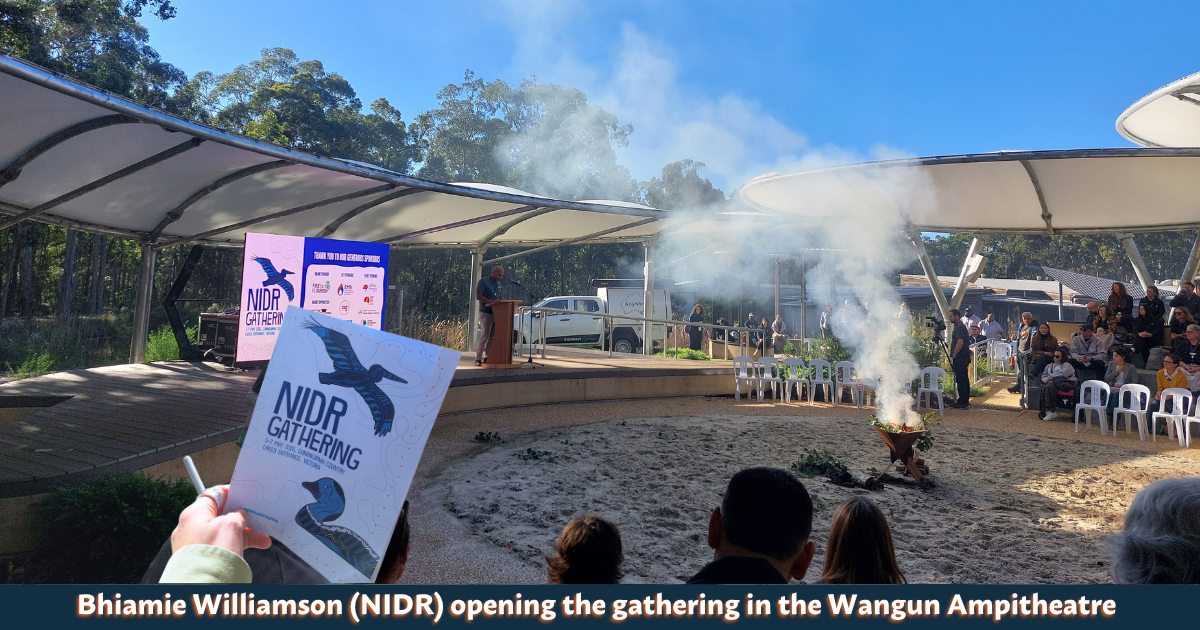
Uncle Wayne Thorpe, Elder, songman and member of the Elders' Council of the Gunaikurnai Land and Waters Aboriginal Corporation (GLaWAC), welcomed us to Country in the beautiful Wangun Amphitheatre, on a crisp morning. He set the stage for an event in which delegates were asked to listen carefully, and those of non-Aboriginal heritage were to interrogate their ways of working with First Peoples in disaster resilience and response.
Read here for a more detailed retelling of the gathering by NIDR.
Plenary and Keynote Sessions: Listen, Learn, Decolonise, Heal
The gathering was an incredible demonstration of the breadth of disaster preparation, resilience and recovery programs First Nations organisations are leading, often unrecognised and un(der)funded, as A/Prof Bhiamie Williamson (NIDR) made clear during the opening plenary.
'Resilience lives in Country as much as it does in people.'
'Disasters reshape people and the cultural fabric of place', said Uncle Troy McDonald, speaking of resilience. Rather than a shallow ‘Build back better’ policy after disasters, he discussed the ambition to ‘Build back (with) community’. Reshaping the approach is critical to self-determination, as resilience is embedded in the connection between people and people, and people and place. A ‘build back with community’ approach validates active custodianship rather than a passive ethic of care. GLaWAC stands for self-determination and Nation building, he explained, and the Wangun amphitheatre is an example of what can be created through meaningful co-design.
'How can we prepare and adapt so we don’t have to bounce back?'
Uncle Russell Mullett shared his lived experience of disasters and, speaking of foods and fires, reminded us that one disaster compounds the next, and that it takes a long time for Country to heal. Adding to this point, Traditional Owner, educator and cultural burning practitioner Brandon Hood (Dept CEO of Bung Yarnda/ Lake Tyers Aboriginal Trust) spoke of mental and physical disaster recovery and adaptation. He explained that before colonisation, no one died in bushfires, saying 'if you take care of Country, Country takes care of you'.

'Our ancestors are not hazards'
Dr Darren Ngaru King (Aotearoa, Independent Research Fellow) held a humorous and poignant keynote address about personal reflections focusing on Māori lessons of disasters and how to decolonise research practice. To successfully prepare for worsening climate impacts and natural phenomena, Dr King highlighted the benefit of differences in knowledge, practice and belief through plural methodology exchange. Professor Jonathan Procter (Massey University) and Lucy Kaiser (Earth Sciences New Zealand) also spoke on Māori ways of knowing and the solutions focus of Indigenous knowledge systems. On the topic of language, they explained that rather than calling disasters ‘hazards’, they like to describe them as ‘natural phenomena’, because ‘our ancestors are not hazards’.
'Disasters don’t discriminate; people do!'
Another inspiring keynote was given by Coral Lever (First Nations Response), who set up a mutual aid service for her community during Covid. Speaking of self-determination and systems change, she highlighted that while the funding sits with those in power, the trust to support Community lies with Community. This was a stark reminder that mutual aid saves lives while the larger systems must be transformed.

Workshops and Panels
With a very rich program, it was hard to choose between the sessions. Here is a glimpse of what was discussed at those I attended.
'County in our hands'
A panel of staunch First Nations Youth spoke on their lived experiences of disasters, disaster response and climate action. The conversation highlighted the need for proactive mental health care, appropriate compensation and employment opportunities and the importance of culture and family.
'Good Fire, Good Future'
'Good fire' conversations demystified cultural burning as a practice to care for and heal Country.
Some key takeaways include:
-
A critical observation: 'Traditional Owners' input is always asked for after disasters have occurred. This needs to be flipped.' Matt Shanks (Taungurung Land and Waters Council).
-
‘Everything goes back to funding’ on the road to self-determination, and the red tape for cultural burns must be cut. Chief Ruth Massie (Yukon First Nations Wildfire).
-
Traditional Owners should be enabled to practice cultural burns, thus caring for Country and involving the youth.
'Harnessing Indigenous Healing for Recovery'
Dr Carlie Atkinson (We Al-li) explained the ‘Healing hub activation model’, based on an intergenerational trauma framework and the '7 core values' designed by Dr Judy Atkinson. The core value of 'resilience' was reframed to mean preparedness and adaptation and the permission of emotional vulnerability. This is necessary, she explained, as resilience can be weaponised to individualise vulnerability, echoing other discussions at the gathering. Dr Atkinson launched their new Community Activation Kit, a knowledge translation into tangible steps to establish community healing hubs and place-based adaptation. It was a pleasure meeting Dr Carlie Atkinson in person, as she was a key figure in the documentary 'Floodland' about the impacts of the Lismore floods, which Act on Climate screened at Parliament House earlier this year. 'The challenge for healing hubs is the prevention of burnout for key organising figures and community leaders, and the lack of funding.'
Deepening the conversation on trauma response, Eliza Munro (MacKillop Seasons) presented their framework ‘Seasons for Healing’ to address grief and trauma of First Nations people across ‘Australia’, with specific tools to address nature- and climate-related feelings.
'Heat, health, housing'
Heat kills more people than any other disaster across ‘Australia’, and 89% of those who die in heat have disabilities. Extreme heat and its effects expose many social and climate justice issues. 'Collectivising the story of ‘heat change’ has to be SYSTEMIC, TRANSFORMATIVE AND URGENT!' and 'we must push back on the narrative of 'individual vulnerability' to heat, and the clinical othering of ‘the vulnerable’', said Emma Bacon (Sweltering Cities). This is particularly relevant in the NT, where people are made increasingly at risk by policy and top-down decisions.
Lauren Mellor (Original Power) and Vanessa Napaltjarri Davis (Tangentyere Council Research Hub) illustrated the injustice of heat in their presentation on prepaid electricity in the NT, which systematically leaves First Nations communities without power in dangerously hot circumstances. They discussed solutions identified through their research and called for coordinated heat safety planning and an integrated Indigenous National Heat Strategy.
Cultural Burning: Witnessing Good Fire
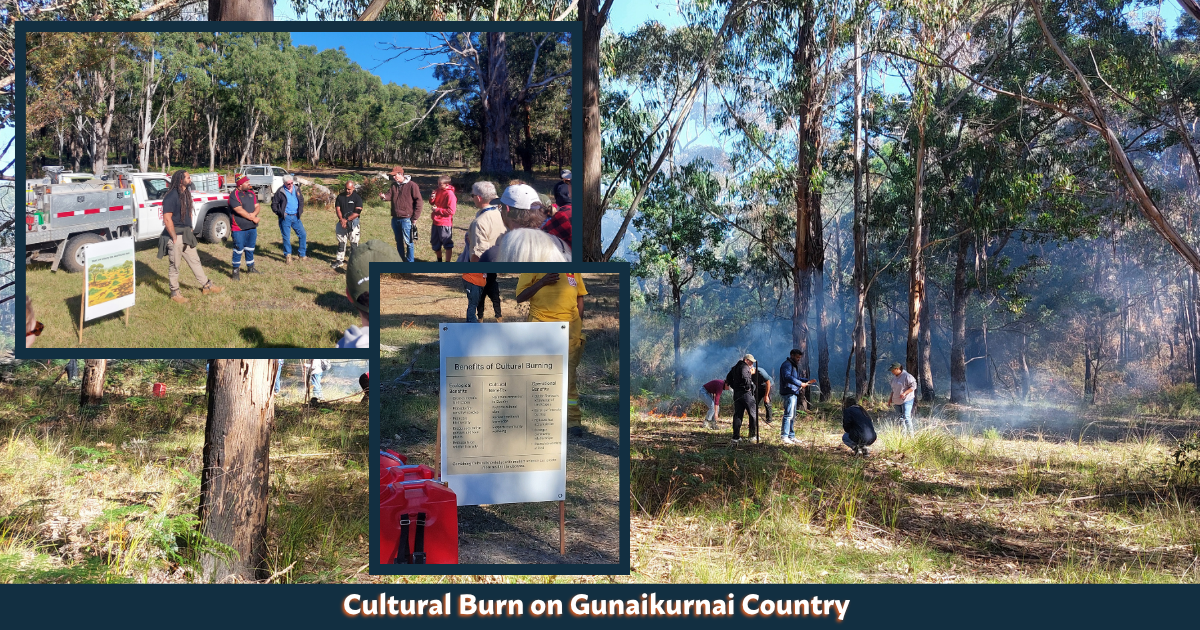
It was another crisp morning, and the dew was clinging to the grass and shrubs, as we gathered outside Bung Yarnda/ Lake Tyers Aboriginal Trust, on the edge of a beautiful forest, sitting on hay bales surrounding a fire. Using illustrations of cultural burns, the differences between planned and cultural burning were explained by Brandon Hood and other Traditional Owners from across so-called ‘Australia’, highlighting the diversity of cultural burning practices.
Some key takeaways:
-
'Country will tell you when to burn and when not to burn'
-
The relevance of First Nations-led fire programs was underlined by the reality that First Nations communities are often forgotten during wildfires and under-supported afterwards.
-
The benefits of cultural burns for Country and People is evident, yet cultural burns still have to abide by CFA or RFA regulations.
-
The difference between the definition of ‘Low intensity burns’ by agencies, compared to the definition of TO’s is jarring.
-
TOs currently can't receive compensation for their services, except for educational purposes, which is wildly unjust.
-
Reintroducing cultural practice will ensure better outcomes for Community.
-
People’s relationship with fire must be changed. Part of this changing relationship, can be the practice of cultural burning.
Reflection on Good Fire
When the dew had lifted, it was time to start the burning. Equipped with rakos, matches and lighters, we split into small groups to begin the burn. It was to be low intensity, a cool burn easily identified by the white smoke. We were reminded that ‘our assets are in the landscape’ therefore, we were to work with Country, rather than against it.
After listening to and watching the experienced cultural burners, including Charmaine Sellings from the Bunjil Brigade, we were encouraged to participate. At first tentative, the activity became fun quickly, and we went deeper and deeper into the smoke, observed the way the fire moved and spread, what worked as kindling, and what didn’t. For hours, some of us were absorbed in the duty of watching, spreading and guiding the fires, creating a mesmerising mosaic of burned patches.
Participants who had previously been afraid of fire, because of their lived experience of wildfires, described their participation in the burn as ‘healing’.
Conclusion: First Nations-led, Funding and Responsibility
The gathering brought together representatives from disaster resilience and emergency management sectors, government, academia, researchers, non-government organisations, Aboriginal Community Controlled Health Organisations, Indigenous ranger groups, Native Title groups, and other land and water management organisations to strengthen awareness, share knowledge, connect, and amplify Indigenous-led conversations on disaster resilience.
Reflection
What really resonated for me, as a settler descendant and only recently having moved back to so-called 'Australia', was the notion of Community not wanting to be resilient anymore, but wanting to be safe, and the danger of resilience being weaponised to individualise vulnerability. Safety of Community depends on First Peoples being able to care for and heal Country, which means cutting a huge roll of red tape, funding First Nations organisations adequately and long-term and shifting the focus from recovery to preparation and adaptation. 'Mob knows what’s best for mob', and our responsibility as allies is to support the self-determination of First Peoples and to engage in meaningful and respectful collaborations with mob leading the way, every step of the way. After all, this always was and always will be Aboriginal Land.
- Aboriginal and Torres Strait Islander People and Indigenous people from across the globe are leaders in adaptation, resilience and disaster preparedness.
- First Nations Communities’ self-determination must be respected in all spheres. This means not just consulting with and listening to Indigenous perspectives, but First Peoples must be enabled to lead adaptation and resilience, and be funded to do so. This requires a lot of red tape to be cut!
- Disaster preparation and response funding must be ongoing to achieve lasting and transformative outcomes for Community and Country.
- First Nations custodianship of Country must be ingrained in decision-making on all levels of governance.
- We must resist the narrative of 'individual vulnerability' and recognise and address the extreme injustices that put Community at higher risk from disasters.
At the gathering’s closing, Uncle Wayne reminded us of the unnaturalness of so-called 'natural disasters' and how they are very much human-made. He encouraged us to 'free our minds of the introduced disaster' (i.e. colonisation)!
Thank you to the Gunaikurnai people who welcomed us to their lands and shared knowledge with us, along with other Indigenous folks from so-called 'Australia' and other places. Thank you also to the organisers of the gathering: GLaWAC, NIDR and the Jagun Alliance.
Indigenous Initiatives Leading the Way
Examples of Indigenous initiatives and organisations present at or mentioned at the gathering:
-
National Indigenous Disaster Resilience - landing page of NIDR with extensive lists of resources.
-
Jagun Alliance - uses its partnerships with Aboriginal enterprises to implement innovative projects to heal Country through conservation and natural resource management.
-
Fire to Flourish - long-term community impact program providing direct support to communities as the first and last responders to disasters. It supports communities to lead their own recovery and resilience-building. It takes a collaborative approach, tailored to the local Indigenous and broader community context and the priorities of the people who live there.
-
First Nations Response - FNR delivers support for mob: free meals, groceries, essentials and advocacy, under the ethic of: ‘Solidarity not charity’. ‘COVID-19 exposed food insecurity as a serious issue for our communities; however we know it existed before COVID-19 and has continued.’
-
Lake Tyers Aboriginal Trust Country Fire Crew (Bunjil) - The only all-women, all-Indigenous fire crew in the CFA.
-
Country as Teacher - a First Nations-led not-for-profit community practising Respect, Responsibility & Reciprocity where the sparks of Indigenous knowledge reignite the fire within to regenerate the health and wellbeing of Country.
-
Yukon First Nations Wildfire - with a focus on capacity development of Yukon Indigenous youth, their vision is to foster community resilience while incorporating traditional knowledge and practices in the delivery of Emergency Management services in the Yukon and Canada.
-
We Al-li - provide a Culturally Informed Trauma Integrated Healing Approach (CITIHA) to training for individuals, families, communities and organisations.
-
MacKillop Seasons - The Stormbirds Disaster Readiness Initiative is designed to build the capacity of schools and communities to support their children, young people, adults, and staff to strengthen resilience and adaptive capacity to extreme weather and disaster events.
-
Country Needs People - a campaign calling on decision-makers to: double the number of Indigenous rangers, create a fund for ranger training, capacity building, networking and capital costs, double the funding for the Indigenous Protected Area (IPA) program, and ensure equal employment opportunities for women rangers by 2030.
-
Original Power - a community-focused, Aboriginal organisation that builds the collective power of our people and backs our leadership, skills and capacity to genuinely achieve self-determination in our community and on Country.
-
Gunaikurnai Land and Waters Aboriginal Corporation (GLaWAC) - Host of the 2026 NIDR and the registered Aboriginal Party that represents all Gunaikurnai people in native title, cultural heritage, land, water and natural resource management and related employment aspirations and issues.
-
Wurrundjeri Woi Wurrung Cultural Heritage Aboriginal Corporation
Suggested watching, reading and listening
-
Floodland documentary featuring Dr Carlie Atkinson (We Al-li)
-
First Nations Wildfire Evacuations: A Guide for Communities and External Agencies by Tara K. McGee and Amy Cardinal Christianson (book)
-
Planning Evacuations with Indigenous Communities - Australian Institute for Disaster Resilience (report)
-
Good Fire Podcast (podcast)
Read about the 2024 NIDR gathering in Bundjalung Country here.
Together we can help prepare communities for now unavoidable climate impacts!
Get in touch if you'd like to get involved or hear more about what we're doing:
- Kimmi Bebendorf: [email protected], or
- Kim Croxford: [email protected]
Support the Act on Climate collective!
Want to help ensure we can continue doing the vital work of preparing Vic communities for climate impacts? Please help us continue our work preparing communities for locked-in climate impacts by making a once-off donation or signing up for monthly donations and becoming a member of AoC.
Act on Climate is actively bringing together people around Vic preparing their communities, generating impactful adaptation from the grassroots, while pressuring the Vic Gov to adequately fund community-led climate adaptation.
Donations will go towards a 2027 Climate Adaptation Fair and enable us to continue free Community Resilience Mapping and other events.