
The Victorian Government released its response to the Climate Resilience Inquiry report in early February 2026. The report included multiple recommendations for more funding; but in its reply, the Victorian Government has ignored this, stating that it is already funding adaptation.
This is at odds with the Inquiry’s evidence, which showed significant financing gaps. And Victorian’s were loud in calling them out.
The Government’s response to this Inquiry missed an opportunity to back Victorians’ appeal for funding that would safeguard the state’s economic future, saving immense costs due to climate impacts down the line and, most importantly, saving Victorian lives.
🧑💻 Read more below on Act on Climate's response to the Government's response to the Resilience Inquiry. And read The Climate Change Exchange's take on the Government's response, which is a brilliant commentary on how there is little clarity about how it intends to systematically strengthen resilience, here: Victorian Government Response to Climate Resilience Inquiry short on equity and justice
📣 Take action now by emailing the Treasurer to tell them to not dismiss Victorians’ appeal for more funding to prepare for climate impacts and to adequately fund adaptation in this year’s Vic state budget through a Victorian Community Climate Adaptation Fund.
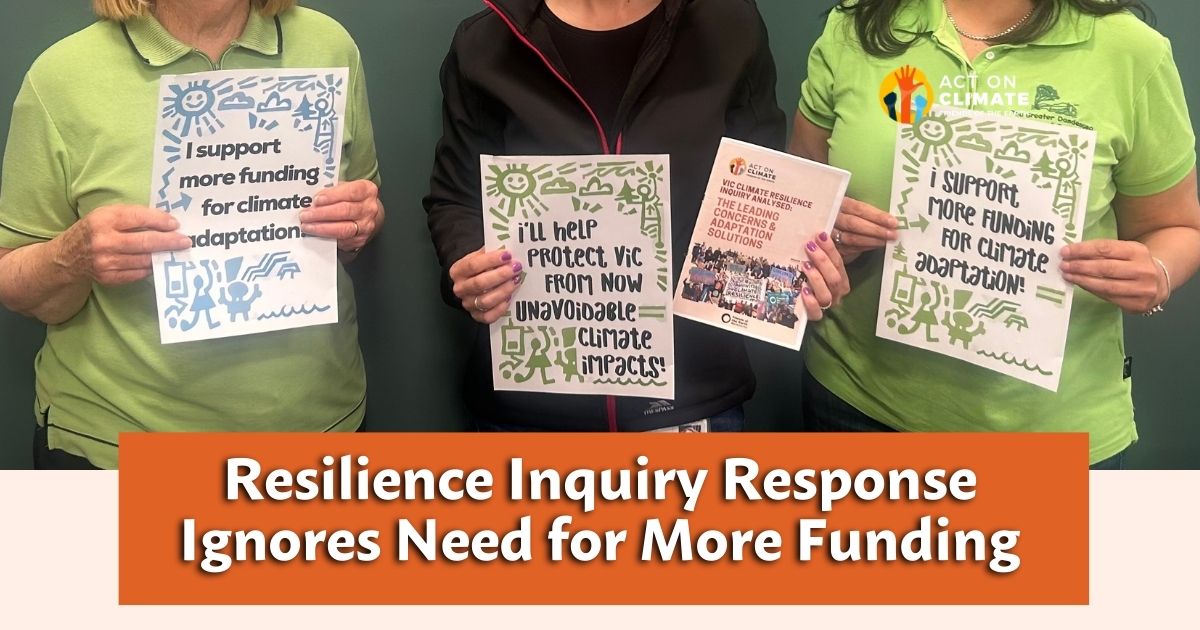
Friends of the Earth’s Act on Climate collective is disappointed to see that more funding to prepare the state for climate impacts and disasters was not an outcome of the Climate Resilience Inquiry. The Inquiry exhibits evidence of significant financing gaps and loud calls for the Government to address these.
In its response to the Inquiry, the Government acknowledges the need to prepare, saying it “shares the Committee’s view that strengthening climate resilience requires a shift from reactive responses to climate impacts towards more proactive planning and investments”.
However, where funding has been recommended, responsible authorities note funding is already provided, or they suggest that potential investments are subject to the Government’s standard budgetary process.
The issue with this is proactive investments in preparing for climate impacts are usually lacking in the budget.
In the 2025/26 State Budget, only 21.1 million was invested in preparing for climate impacts, while 243.2 million was invested in responding to climate impacts. This is why Act on Climate and allies have been calling on the Victorian Government to implement a Victorian Community Climate Adaptation Fund (VCCAF) in the state budget.
The Inquiry “identified gaps in implementation and funding for resilience and adaptation initiatives” in the Climate Change Strategy and Adaptation Action Plans (AAPs), as well as Regional Climate Change Adaptation Strategies. Our question is how and when will these adaptation strategies and plans be funded?
Without funding, these strategies and plans will not be actioned.
Response to recommendation to adequately fund orgs
Specifically, Recommendation 63 from the Climate Resilience Inquiry advises “that the Victorian Government provide adequate funding to local government and community-based organisations to raise public awareness and build climate resilience”.
This was only supported in principle, with the Government commenting: “There is a range of Victorian Government funding programs to local government, often with specific or dedicated purposes and criteria aligned with respective portfolios. There is provision to include funding toward climate resilience adaptation activities for infrastructure where appropriate.”
However, the Inquiry found that climate adaptation and resilience investment stretches many local councils’ financial capacity, and financial constraints limit the provision of services by community organisations that play an important role in supporting communities to prepare for climate change, preventing communities from enhancing their climate resilience.
Councils and community organisations clearly noted in their submissions that current funding is not adequate, with the costs of adapting cities and infrastructure escalating. The City of Melbourne shared in its submission that the average annual damages to its assets from climate hazards are projected to increase by 1,200% in the next 75 years.
There was a strong appeal overall from Victorians for adequate funding of climate adaptation in Climate Resilience Inquiry submissions. Over 80% of respondents called for more funding, including councils, community and other organisations, and community members.
In addition, the response to Recommendation 63 noted above does not mention funding for community organisations. We have asked the Treasurer to clarify the department's response to this.
Before, during and in the aftermath of the climate impacts this summer, community organisations and neighbourhood houses were the ones supporting people to prepare, stay safe, and recover.
Transparency of funding & progress lacking
In its response to the Inquiry, the Government also acknowledges that “understanding funding for resilience activities can be challenging and would be assisted by clear attribution”. The amount spent on climate adaptation needs to be clearly distinguished in the budget, including a clear distinction between funds going toward preparing for climate impacts and funds going towards response and rebuilding due to climate impacts. Act on Climate has also been calling on the government to include a Climate Impact Statement in the state budget.
Transparency into the calculations and considerations of funding required to adequately prepare Victoria for imminent climate impacts is needed. Victorians should be given insight into this process, as well as being provided transparency on what the Victorian Government deems as an adequate amount of funding.
The Resilience Inquiry Parliamentary Report found that “greater transparency and accessibility of progress updates is urgently needed to ensure accountability, public trust, and meaningful community engagement”.
Where funding for climate preparedness could & should come from
More investment in preparing Victoria for current and incoming climate impacts could come from an increased contribution from the Victoria Government in the Disaster Ready Fund (DRF). Act on Climate has been calling on the Government to at least match the Federal Government’s DRF contribution and make this a feature of the budget every year, in the form of a VCCAF, to ensure Victorian communities are as prepared as possible.
Climate impacts are here now and will get worse even if we reduce emissions. This has been confirmed by the National Climate Risk Assessment (NCRA). We need to prepare.
The Committee notes in the Resilience Inquiry report that “funding shortfalls represent a critical barrier to implementing climate resilience initiatives”, adding that “non‑recurrent funding for resilience projects restricts long‑term capacity building and strategic outcomes”.
Climate disasters are already costing Victoria more than $2.7 billion annually. Heatwaves alone cost the Victorian economy $87 million each year. This could grow to $179 million by 2030 (Infrastructure Victoria). Whereas, resilience funding could provide returns of $8.10 for every $1 invested by 2050 (Insurance Council of Australia).
Act on Climate’s proposal for a Victorian Community Climate Adaptation Fund (VCCAF) would ensure community organisations obtain the ongoing localised funding needed to prepare.
A VCCAF is an evidence-based mechanism of providing funding to community‑based organisations to build climate resilience", as shown by the Government’s previous Community Climate Change Adaptation (3CA) grants program. It is one of the two key funding mechanisms proposed by stakeholders in the Inquiry to address the significant financing gaps.
Funding climate preparedness now will save lives, reduce recovery costs, reduce the cost of living, and ease pressure on our health system and economy from climate impacts.
Contribution to Vic’s five-step fiscal strategy by creating jobs and reducing cost of living
Funding climate adaptation will contribute to step 1 of Victoria’s five-step fiscal strategy by creating jobs and reducing unemployment. Work generated by climate adaptation includes construction through physical defence systems such as sea walls, shade cloths over playgrounds, infrastructure upgrades, retrofitting houses and workplaces to be climate safe, environmental protection and restoration, and human services that prepare people through education.
It will also contribute to step 1 by reducing cost of living and thus helping to restore economic growth. Climate adaptation solutions are shown to reduce Victorian’s energy costs, increase their food security, increase their health and wellbeing, reducing health costs and isolation.
Questions for the Treasurer
Act on Climate has emailed the Treasurer, Jaclyn Symes and asked:
- Will more proactive investments in preparing for climate impacts be a feature of this year’s budget?
- Will funding for the AAPs be included in the 2026/27 State Budget?
- Will the amount spent on climate adaptation be clearly distinguished in this year’s budget, including a clear distinction between funds going toward preparing for climate impacts and funds going towards response and rebuilding due to climate impacts?
- Why are calls to properly invest in climate adaptation being rejected?
We look forward to the Treasurer's response to these questions and we hope to see a VCCAF in the 2026/27 State Budget!
Don't let the Vic Gov ignore victorians' call for more funding and help us get a VCCAF in the 2026/27 budget!
- send an email to the Treasurer sharing your disappointment in the response to the Inquiry
and asking for proper adaptation funding in this year’s state budget.
Find our pre-filled template and suggested questions to include here.
Inquiry also falls short on equity and justice
A lack of clarity around and action towards more funding for preparing for climate impacts is not the only failing of the Government's response to the Climate Resilience Inquiry. "While the response acknowledges the increasing threat and impacts of a changing climate and the need for urgent and ongoing adaptation, there is little clarity about how it intends to systematically strengthen resilience in the communities facing the greatest cumulative pressures," The Climate Change Exchange notes in an article it prepared on its analysis of the Government's response. In the article, it shares the response lacks specificity about how adaptation measures will be equitably accessed:
"Without explicit equity mechanisms such as targeted investment, accessibility standards, tenant protections and community-led planning - adaptation risks reinforcing existing social and spatial inequalities rather than reducing them."
The article also echoes Act on Climates criticism around funding.
Read The Climate Change Exchange's full article on the Government's response to the Climate Resilience Inquiry here: Victorian Government Response to Climate Resilience Inquiry short on equity and justice
Together we can help prepare communities for now unavoidable climate impacts!
Get in touch if you'd like to get involved or hear more about what we're doing:
- Vicky Ellmore: [email protected], or
- Kimmi Bebendorf: [email protected], or
- Kim Croxford: [email protected]
Remember, you're always welcome to join Act on Climate's weekly meetings. Our organising and action meetings will take place on the alternative fortnight to the Organising Training Workshops.
All weeks include dinner. Register here for an upcoming Tuesday.
Support the Act on Climate collective!
Want to help ensure we can continue doing the vital work of preparing Vic communities for climate impacts? Please help us continue our work preparing communities for locked-in climate impacts by making a once-off donation or signing up for monthly donations and becoming a member of AoC.
Act on Climate is actively bringing together people around Vic preparing their communities, generating impactful adaptation from the grassroots, while pressuring the Vic Gov to adequately fund community-led climate adaptation.
Donations will go towards a 2026 Climate Adaptation Fair and enable us to continue free Community Resilience Mapping and other events.