
'The networks we rely on face a growing risk from natural disasters' (ABC). A response to Infrastructure Victoria's latest report 'Warning Signs' on the threat of 'natural disasters' to Victorian infrastructure by Act on Climate Collective Member Dave Robertson.
Infrastructure Victoria has warned that at least $57 billion worth of infrastructure is at risk from climate disasters like bushfires, floods and extreme heat. With these events intensifying and becoming more frequent as the climate crisis worsens, we put it to the government to take urgent action. There should be a substantial commitment by the Victorian Government to support climate adaptation to protect our environment, our infrastructure and thus Victorians from future risk rather than from damage that has already occurred.
In the Act on Climate collective within Friends of the Earth, our Frontline Climate Alliance members – grassroots activists at the forefront of adaptation – are making similar warnings in their local areas across Victoria. As the climate crisis worsens, state infrastructure such as roads and railways is coming under increasing pressure.
In our submission, we told the Climate Resilience Inquiry that 80% of Victorians want to see more funding for climate adaptation. And in our submission to the 30-year VIC infrastructure strategy we stated that: 'Climate adaptation needs to be a focus of every part of infrastructure planning and strategy because climate change will inevitably affect every part of our society' and we pointed to the focus on 'social recovery' rather than the urgent social preparation needed.
Yet, the government appears to have decided that they are already allocating enough resources. Earlier this year, we reported that climate disasters are already costing Victoria more than $2.7 billion annually. Heatwaves alone cost the Victorian economy $87 million each year. This could grow to $179 million by 2030 (Infrastructure Victoria).
‘Adaptation’ and ‘resilience’ cannot simply mean protecting roads, ports and power infrastructure from the most direct consequences of climate disasters. ‘Adaptation’ means looking at future risks and ensuring that communities are protected against them. This includes taking action on predictable events of extreme heat and flooding, which not only physically threaten Victorians but also indirectly through monetary pressures such as increased insurance costs. We must care for Victorians who are most at risk from climate impacts, including First Nations people, renters, public housing residents, people with disabilities, low-income households and rural communities, and people living in Naarm/Melbourne's heat-exposed outer suburbs, like the city's outer west, east and north.
Of the recommendations given in Infrastructure Victoria's strategy, we particularly support 1. 'Fund councils to plan and build libraries and aquatic recreation centres in Melbourne’s growth areas', especially if longer opening hours are extended so people may seek refuge and in the case of extreme weather events and 2. 'Open up more public land in fast-growing suburbs. Plant more trees on local streets to help get to 30% tree canopy cover in urban areas' by 2030.
Act on Climate is calling for major and long-term Victorian Government investment in community climate adaptation and resilience, including:
- climate-safe public and affordable housing
- free home energy and cooling retrofits
- expanded urban tree canopy and cooling infrastructure
- flood-resilient public transport and community facilities
- neighbourhood cooling hubs and emergency refuges
- publicly owned renewable energy and storage
- wetland and ecosystem restoration to reduce flood and bushfire risk
Exposure to risk from climate impacts is heavily entangled with socio-economic status. We cannot prepare Victoria for climate change while social disadvantage keeps growing across Victoria. The most climate-safe communities are those with strong government services, affordable housing, healthy ecosystems and reliable renewable energy.
Real climate adaptation means building a fairer and more connected society that can withstand the shocks ahead.
The Department of Infrastructure's own findings demonstrate the urgency of rapidly reducing emissions while simultaneously investing in large-scale adaptation measures across Victoria. We join the Department of Infrastructure in appealing for more funding to prepare Victoria for climate impacts and to adequately fund adaptation.
Call to Action
Sustainable Cities, a sibling collective at Friends of the Earth Melbourne, campaigns for better public transport, and specifically for 'Better Buses in the West'.
Support their upcoming events!
Transport Justice Rally | Steps of Parliament 12pm, June 18th

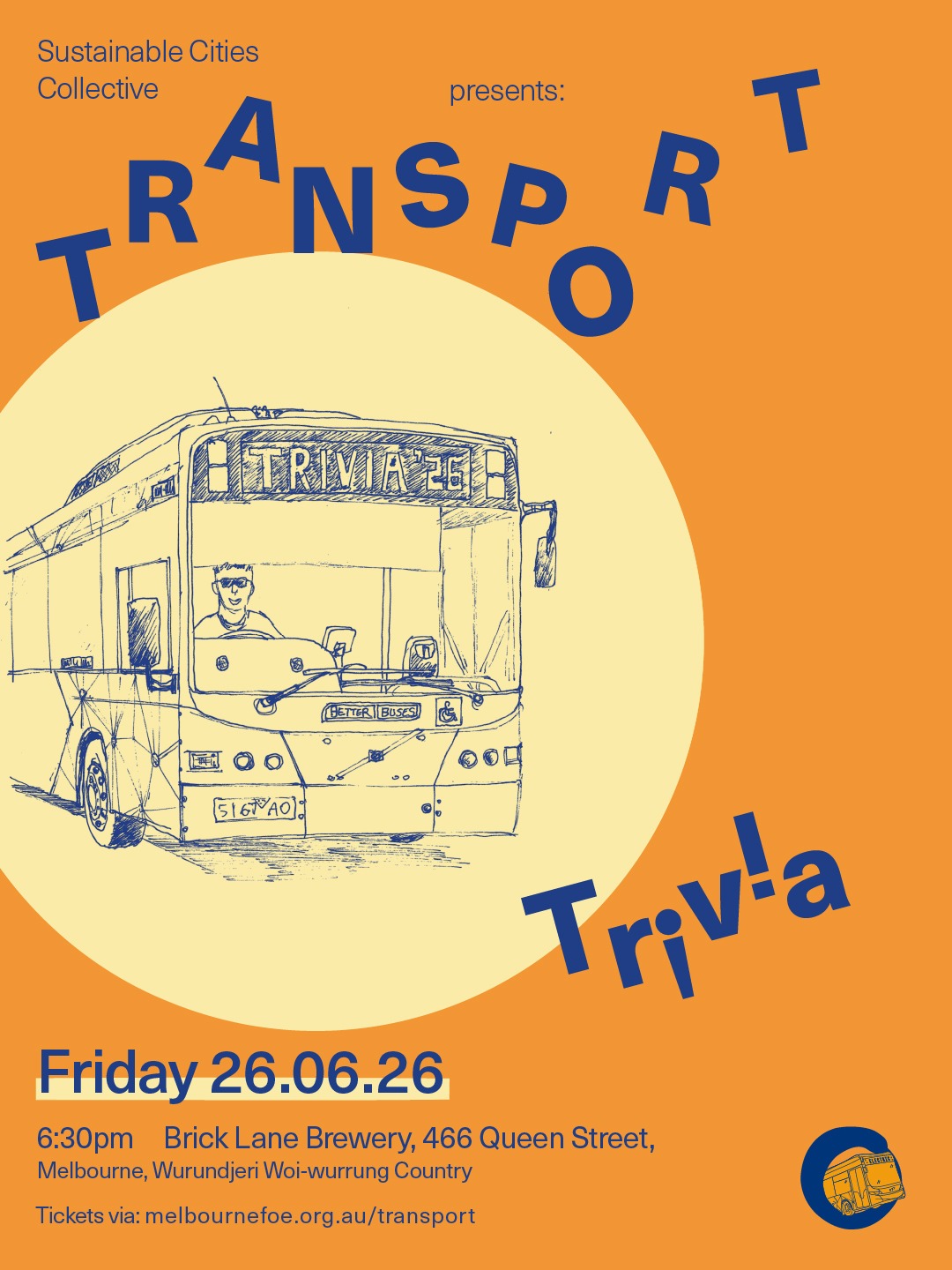
Sustainable Cities' Famous Transport Trivia | 6pm, June 26th
This article is an opinion piece by collective members of AoC and does not reflect the official opinions of Friends of the Earth Australia or Friends of the Earth Melbourne.
Together we can help prepare communities for now unavoidable climate impacts!
Get in touch if you'd like to get involved or hear more about what we're doing:
- Kimmi Bebendorf: [email protected], or
- Kim Croxford: [email protected]
Remember, you're always welcome to join Act on Climate's weekly meetings. Our organising and action meetings will take place on the alternative fortnight to the Organising Training Workshops.
All weeks include dinner. Register here for an upcoming Tuesday.
Support the Act on Climate collective!
Want to help ensure we can continue doing the vital work of preparing Vic communities for climate impacts? Please help us continue our work preparing communities for locked-in climate impacts by making a once-off donation or signing up for monthly donations and becoming a member of AoC.
Act on Climate is actively bringing together people around Vic preparing their communities, generating impactful adaptation from the grassroots, while pressuring the Vic Gov to adequately fund community-led climate adaptation.
Donations will go towards a 2027 Climate Adaptation Fair and enable us to continue free Community Resilience Mapping and other events.